
 English
  Korean
  French
  German
  Hungarian
  Japanese
  Russian
What Is Pvc in Handbags?
Here’s the blunt truth: if you’re asking what is pvc in handbags, you’re really asking how to get durability, style, and sane production costs without cutting corners. PVC is the behind-the-scenes workhorse—waterproof, shape-holding, logo-loving plastic that keeps cosmetic bags sharp on shelves and steady in suitcases.
Brands don’t pick PVC by accident. It wipes clean after a mascara spill, holds bold prints without fading, and can go clear, glossy, or matte depending on the vibe. For bulk orders, it behaves—consistent thickness, easy heat sealing, fewer production headaches. That means fewer returns and less drama when deadlines loom.
According to Grand View Research’s 2024 update on the global polyvinyl chloride market, demand remains strong across consumer goods due to durability and cost efficiency, while Allied Market Research projects continued growth in PVC applications through the decade, driven by packaging and everyday products. The material’s staying power isn’t hype—it’s documented market momentum.
What Is PVC In Handbags And Why?
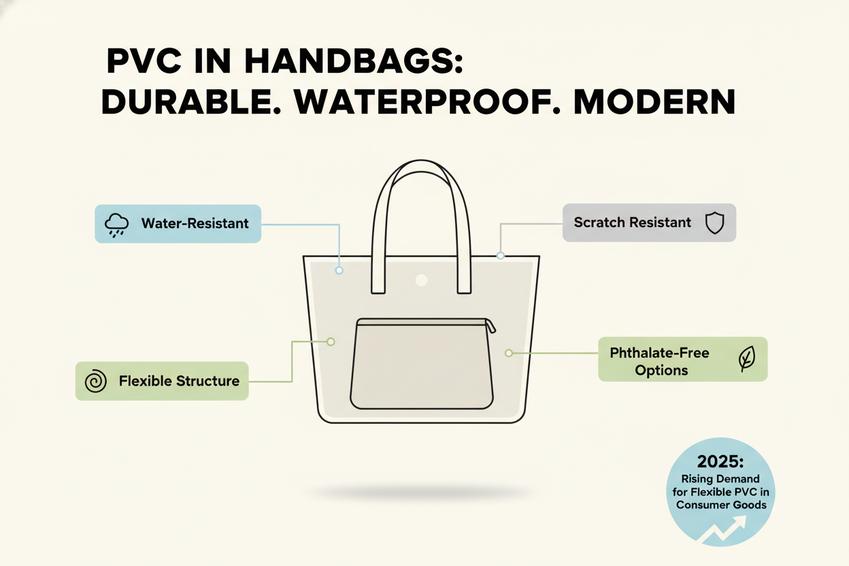
If you’ve ever asked what is pvc in handbags, you’re not alone. From clear totes to glossy crossbodies, PVC shows up everywhere. Let’s break down what PVC in handbags really means and why brands love it.
Defining PVC (Polyvinyl Chloride): Material Properties Overview
When people search what is pvc in handbags, they’re really asking about material basics.
- PVC stands for polyvinyl chloride, a synthetic thermoplastic.
- It’s known for steady thickness and consistent production quality.
- In handbags, it acts as a flexible outer shell.
To understand PVC in handbags clearly, look at its core material traits:
- Composition
- Made from vinyl polymer chains.
- Engineered for stable surface integrity.
- Physical Features
- Built-in resilience against daily wear and tear.
- Strong bonding that supports sealed seams.
- Functional Benefits
- Acts as a natural moisture barrier.
- Maintains shape without losing longevity.
So when someone asks, what is pvc in handbags, the short answer is simple: it’s a practical plastic material designed for structure, shine, and everyday reliability.
Durability & Waterproof Performance in Everyday Use
PVC in handbags stands out because of its water resistance and daily resilience.
Here’s how it performs in real life:
- Coffee spills? Wipe and go.
- Rainy commute? No soaked lining.
- Beach trip? Sand shakes off easily.
Performance layers include:
- Outer Shield
- Dense coating forms a moisture barrier.
- Protects contents from light rain.
- Structural Strength
- Heat-sealed seams reduce splitting.
- Minimizes wear at stress points.
- Long-Term Use
- Slows down tear around handles.
- Supports product longevity.
According to Grand View Research’s 2025 plastics market update:
“Demand for flexible PVC in consumer goods continues to rise due to its durability and cost-efficiency in waterproof applications.”
That’s why brands like Topfeel use PVC when designing travel-friendly totes and event bags. It’s about practical application, not hype. When shoppers wonder what is pvc in handbags for daily commuting, the answer often comes down to simple waterproof performance.
Transparency, Flexibility, and Scratch Resistance Explained
One big reason PVC handbags trend online? The clarity.
PVC supports:
- Crystal-clear see-through styles
- Soft pliability for curved silhouettes
- Controlled bendability without cracking
Material behavior breaks down like this:
- Visual Appeal
- High clarity enhances modern aesthetics.
- Tinted finishes boost visual appeal.
- Structural Movement
- Flexible body adapts to contents.
- Maintains surface integrity after folding.
- Surface Defense
- Moderate scuff resistance.
- Handles light abrasion with proper care.
So when someone types what is pvc in handbags, part of the answer is style freedom. Clear stadium bags, glossy minis, bold neon trims—all possible because PVC balances shape and softness.
Phthalate-Free PVC as an Eco-Friendly Handbag Choice
Today’s shoppers care about composition. That’s where non-phthalate PVC comes in.
Modern handbag manufacturing may include:
- Non-toxic plasticizers
- Lead-free pigments
- REACH-compliant formulas
Sustainability layers explained:
- Material Safety
- Uses safer choice additives.
- Reduces harmful chemical migration.
- Environmental Impact
- Lower long-term environmental impact with regulated sourcing.
- Improved recyclability potential.
- Responsible Production
- Focus on sustainable material inputs.
- Encourages responsible supply chains.
For brands like Topfeel, offering phthalate-free PVC options signals a shift toward a green alternative without losing durability. So when customers ask what is pvc in handbags today, the better answer includes safer composition and smarter material choices.
In simple terms, PVC in handbags isn’t just plastic—it’s engineered performance, modern design freedom, and, increasingly, a more conscious material decision.
3 Misconceptions About PVC In Handbags
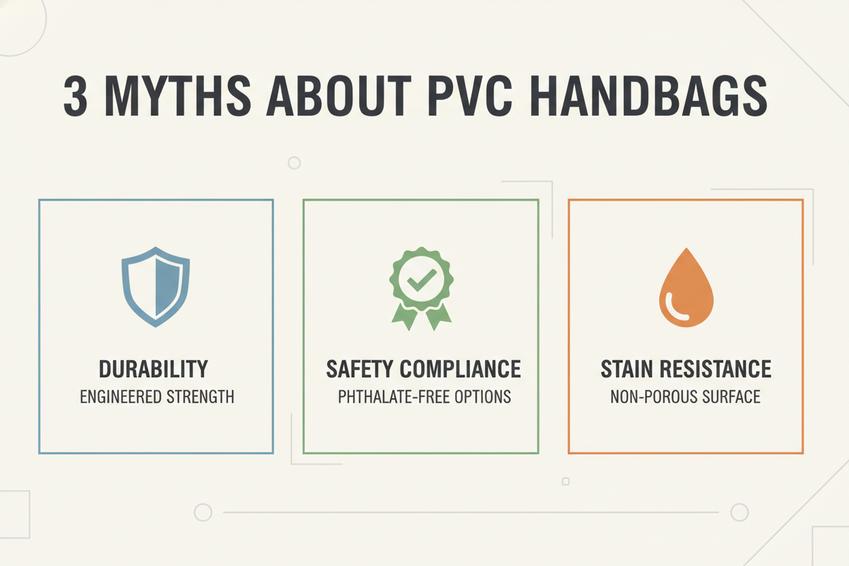
When people ask what is pvc in handbags, the answers online can feel all over the place. Some say it cracks fast. Others worry about safety. Let’s clear the air and break down what PVC in handbags really means in everyday use.
PVC Handbags Wear Out Quickly
A lot of shoppers typing what is pvc in handbags assume PVC material equals low durability. That’s not how modern manufacturing works.
- Material Core
- Polyvinyl Chloride (PVC) is engineered for flexibility and strength.
- Controlled material thickness prevents cracking under stress.
- Stabilizers improve resistance to UV and daily wear.
- Construction Standards
-
- Reinforced stitching density reduces seam splitting.
-
- RF welding bonds panels without needle holes.
-
- Strict defect rate monitoring filters weak batches.
-
- Performance Factors
- • Resistance to moisture
- • Shape retention
- • Surface elasticity
Premium manufacturers like Topfeel combine calibrated thickness with precision sealing, so PVC handbags can last just as long as PU or other synthetic bags. In simple terms, durability depends more on production quality than on the material name itself.
All PVC Bags Contain Harmful Phthalates
Here’s where confusion spreads fast. People hear “plastic” and instantly think “toxic.” But asking what is pvc in handbags today requires looking at modern compliance standards.
Short answer: not all PVC contains harmful additives.
Key points:
- Many factories now produce phthalate-free PVC.
- Compliance with REACH regulation ensures restricted chemicals stay below safe limits.
- Lead-free stabilizers are widely adopted in export markets.
According to a 2025 European Chemicals Agency industry briefing:
“The majority of PVC consumer goods placed on the EU market now comply with updated phthalate restrictions under REACH.”
That shift means PVC in handbags can be flexible and transparent without risky additives. Brands such as Topfeel specify non-toxic formulations for international buyers, especially for fashion and cosmetic bags where skin contact is frequent.
So when someone asks, what is pvc in handbags, the better question is: is it certified and compliant?
PVC Surfaces Stain with Ease
Another myth says PVC stains instantly. In reality, PVC surface structure is non-porous, which changes everything.
- Surface Characteristics
- Smooth coating limits liquid absorption.
- Waterproof barrier blocks deep penetration.
- Color pigments bond during extrusion.
- Daily Use Scenarios
-
- Makeup spills → wipe with mild cleaner.
-
- Coffee splashes → no fiber absorption.
-
- Rain exposure → no swelling or warping.
-
- Why It Matters
- ▪ Print adhesion stays stable
- ▪ Color consistency remains intact
- ▪ Cleaning stays simple
Compared with fabric handbags, PVC doesn’t soak up stains into internal fibers. That’s one reason transparent PVC tote bags remain popular in retail and stadium settings.
So, what is PVC in handbags really about? It’s a water-resistant synthetic material designed for durability, safety compliance, and easy maintenance—when produced under proper standards.
Stains On Bag? Easy Cleaning With PVC
Trying to figure out what is pvc in handbags and why it’s hyped for easy cleaning? Let’s break down what PVC means in bags, how it handles spills, and why people keep asking what is pvc in handbags when stains show up.
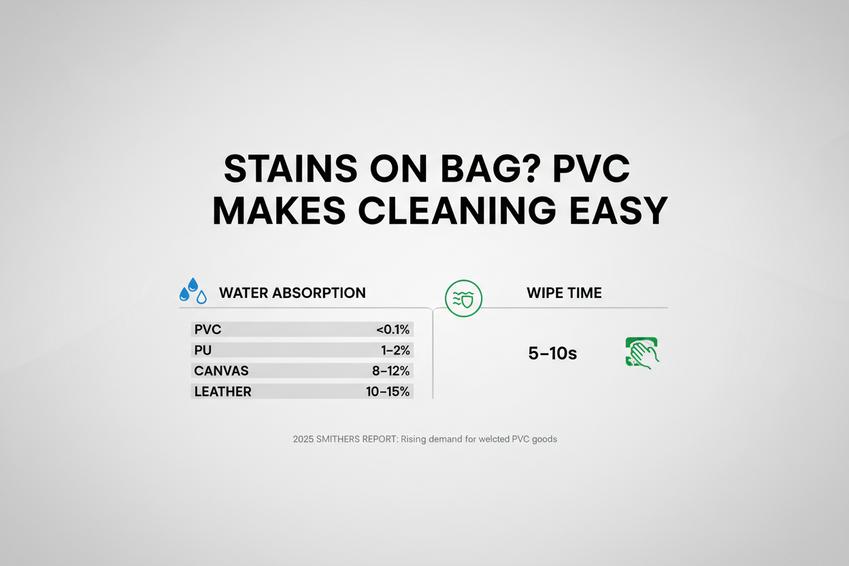
Water Resistance Makes Wiping Off Spills Simple
When people Google what is pvc in handbags, they’re often worried about coffee spills or makeup mess. Here’s the deal—PVC (Polyvinyl Chloride) forms a non-porous surface. Liquids don’t soak in; they sit on top.
- Water beads up instead of spreading
- Oil stains stay on the surface
- Quick wipe restores shine
How PVC Structure Blocks Moisture
- Polymer Layer
- Dense molecular chains
- Limit liquid penetration
- Reduce swelling
- Dense molecular chains
- Surface Coating
- Smooth finish
- Less friction
- Less stain grip
- Smooth finish
- Sealed Edges
- RF Welding
- No needle holes
- No moisture entry
- RF Welding
| Property | PVC Handbag | PU Bag | Canvas Bag | Genuine Leather |
|---|---|---|---|---|
| Water Absorption (%) | <0.1 | 1–2 | 8–12 | 10–15 |
| Wipe Time (seconds) | 5–10 | 15 | 40+ | 60+ |
| Stain Retention | Low | Medium | High | High |
| Maintenance Cost ($/year) | 5–10 | 15 | 20 | 50+ |
So next time someone asks what is pvc in handbags, the short answer? It’s the reason spills aren’t a big deal.
RF Welding & Heat Sealing Prevent Dirt Buildup
Stitch holes can trap grime. RF welding and heat sealing fuse panels together instead of poking through them.
- No thread gaps
- Smooth seam edges
- Stronger joint integrity
Dirt usually hides in seams. With welded construction, dust has fewer places to settle. That’s why many factories, including Topfeel, use sealed seams for cleaner finishes.
According to the 2025 Smithers report on flexible plastics, demand for welded PVC consumer goods continues rising due to “improved hygiene performance and lower maintenance compared to stitched alternatives.”
That’s a fancy way of saying: less scrubbing, less stress.
Non-Toxic Surface Enables Quick Stain Removal
Still wondering what is pvc in handbags from a safety angle? Modern phthalate-free PVC is designed for safer daily use.
✔ Compatible with mild soap
✔ Maintains color consistency
✔ Protects embossed logos
Short and simple. Wipe. Dry. Done.
Brands like Topfeel focus on controlled material formulation, stable pigments, and smooth coating layers. The result? A bag that handles daily chaos without looking wrecked.
So when someone asks what is pvc in handbags, think of it as a low-maintenance, wipe-clean material built for real life.
FAQs about What Is Pvc In Handbags
1. What is PVC in handbags and why is it widely used?
PVC (Polyvinyl Chloride) is a thermoplastic known for its waterproof surface, flexibility, and transparency. In handbags, it acts as a protective shell that guards cosmetics from spills and humidity.
Its appeal comes from three core strengths:
- Stable material thickness for consistent structure
- High durability and scratch resistance for daily travel
- Easy surface care—simply wipe clean
For brands, PVC balances visual impact with dependable water resistance and low defect rates during production.
2. How does PVC support waterproof and spill-resistant designs?
PVC performs like a barrier shield:
- Blocks moisture from entering the lining material.
- Works with RF welding or heat sealing to close seams tightly.
- Strengthens spill containment around zipper closures and compartments.
When seam strength and zipper durability are properly tested, the bag remains travel-friendly even in humid bathrooms or packed suitcases. The tension lies in the details—weak seams fail, but precise welding holds firm.
3. Is PVC in handbags safe and eco-conscious?
Safety depends on formulation and sourcing.
- Phthalate-free PVC reduces health concerns.
- Non-toxic materials, lead-free standards, and REACH compliance protect users.
- Responsible suppliers focus on sustainable sourcing and controlled defect rates.
Some buyers also explore recyclability and eco-friendly alternatives, yet high-quality PVC can meet strict compliance demands while maintaining flexibility and color consistency.
4. How does manufacturing affect PVC handbag durability and appearance?
Performance is shaped in production:
- Die-cutting defines shape accuracy.
- Stitching or RF welding determines seam strength.
- Screen printing and embossing influence print adhesion and surface texture.
Poor technique leads to peeling logos or warped structure. Precise control preserves transparency, smooth edges, and long-term durability. Quality is visible in every corner and zipper pull.
5. What customization options are available for PVC handbags?
PVC adapts easily to brand vision. After defining custom dimensions and compartments, manufacturers can adjust design elements and finishes.
| Custom Feature | Options Available |
|---|---|
| Color | Pantone matching for color consistency |
| Branding | Logo printing, embossed patterns |
| Structure | Custom shape, closure type, handle style |
| Hardware | Zipper pull customization, hardware selection |
This flexibility supports organization, portability, and clear brand identity—while keeping the bag easy to clean and ready for travel.
References
- global polyvinyl chloride market – grandviewresearch.com/Grand View Research
- PVC applications – openpr.com/Allied Market Research
- thermoplastic – springboardmfg.com/Springboard Manufacturing
- production quality – vinidex.com.au/Vinidex
- polymer chains – chandra-asri.com/Chandra Asri
- moisture barrier – researchnester.com/Research Nester
- plastics market update – grandviewresearch.com/Grand View Research
- safer choice – openpr.com/Future Market Insights
- strength – benvic.com/Benvic Group
- REACH regulation – ineris.fr/Ineris
- industry briefing – decachem.com/Decachem
- skin contact – sgs.com/SGS
- pigments – openpr.com/Verified Market Reports
- welded PVC – cti-cert.com/CTI
- soap – qima.com/QIMA


.png)



4th-5th Floor, Building B2, Yin Tian Industrial Park, Xi Xiang Road, Bao'an Dist, Shenzhen, 518102 ,China