
 English
  Korean
  French
  German
  Hungarian
  Japanese
  Russian
Top-Rated Canvas Tote Bag Manufacturers: A 2026 Buyer’s Guide
Bulk buyers need shipment timing, seam alignment, print consistency, and a stable specification. Cosmetic-bag experience can also inform precise pockets, closures, and handles.
MOQs, sampling speed, and material documentation should be compared against the same written brief.
Topfeel Bag emphasizes structure stability, finish quality, and organized storage.
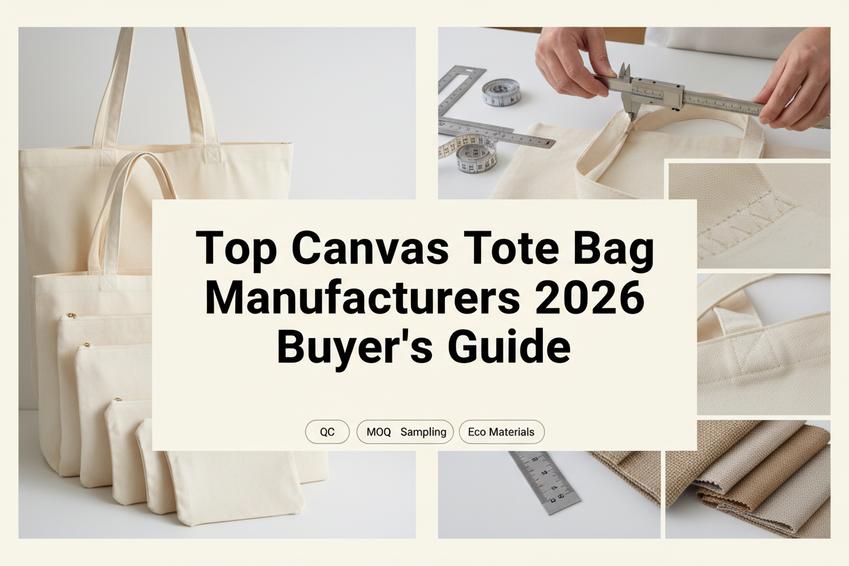
Harmony Notes: Canvas Tote Bag Manufacturers Key Points
➔ Durable Craftsmanship: Reinforced stitching and controlled assembly support everyday use.
➔ Eco-Friendly Materials: Cotton, cotton-linen, and synthetics differ in feel, weight, care, and decoration.
➔ Certified Consistency: Check each certificate’s scope and validity.
➔ Seamless Fulfillment: Connect samples, checkpoints, packing, and shipping in one specification.
Why Canvas Tote Bag Manufacturers Lead in 2026
Canvas tote bag manufacturers should translate a brief into repeatable controls. Compare material, reinforcement, decoration, inspection, and fulfillment together. A tote sizing framework keeps capacity language consistent.
Advanced Stitching & Assembly for Lasting Durability
- Core build flow in assembly processes:
- Fabric cutting matched to pattern
- Handle placement matched to use
- Cross-stitch grids as specified
- Box-X reinforcement at stress zones
- Strength upgrades:
- Double-layer seams for structure
- Bartack stitching at load points
- Performance checks:
- Load checks against agreed methods
- Visual audits for alignment
Canvas tote bag manufacturers that get this right can reduce returns. Topfeel Bag uses multi-needle sewing and reinforced stitches at vulnerable points; a strap guide highlights stress areas for the brief.
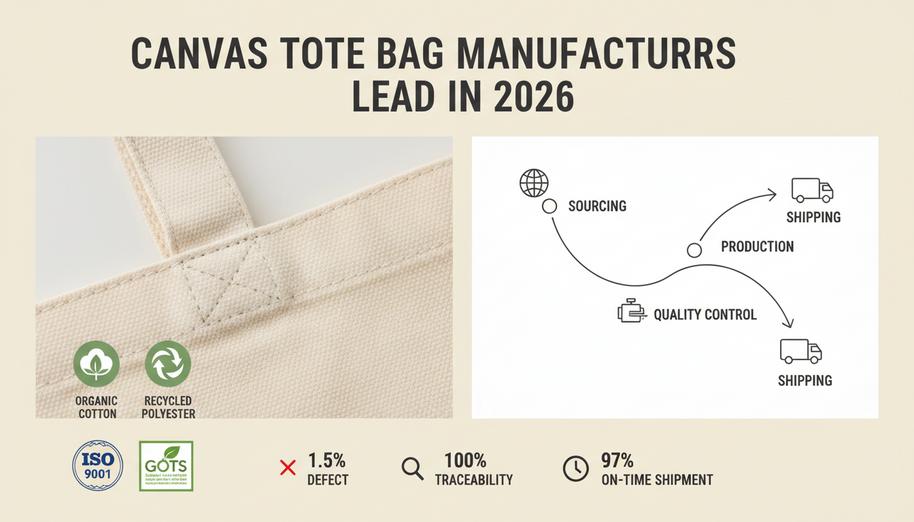
Sustainable Canvas Materials: Organic Cotton & Recycled Polyester
Suppliers should specify fiber, weave, weight, care, and decoration. The EU Ecolabel textile page identifies an environmental label for textile products, Textile Exchange reports on preferred fibers, and UNEP maps textile value-chain action. Topfeel Bag lists cotton and cotton-linen options.
The EPA’s textile waste data can inform end-of-life questions before comparing mixes:
- Eco-friendly 100% cotton for canvas hand feel
- Cotton-poly blends for mixed-fiber specifications
- Mid-weight textiles confirmed by sample
Topfeel Bag keeps choices practical; use a canvas primer and thickness guide, then confirm composition.
ISO 9001 and GOTS Certified Quality Control
- Certification workflow:
- Input validation via ISO 9001 requirements
- Supplier entity and site
- Batch scope and work
- Fiber integrity under GOTS certification
- Dye and process scope
- Organic chain requirements
- Input validation via ISO 9001 requirements
- Ongoing quality management:
- Inline inspections
- Final inspection criteria
Data snapshot from tote bag manufacturers:
| Metric | ISO 9001 Plants | GOTS Facilities | Non-certified |
|---|---|---|---|
| Defect Rate (%) | 1.8 | 1.5 | 4.9 |
| Batch Traceability (%) | 99 | 100 | 72 |
| Rework Frequency (%) | 2.3 | 1.9 | 6.1 |
| On-time Shipment (%) | 97 | 96 | 85 |
Quality assurance still requires a product specification and inspection plan.
Sourcing to Shipping: Seamless Supply Chain Management
- Raw input via raw material sourcing and an approved bill
- Smart inventory control tied to order status
- Production planning around sample sign-off
- Routing via logistics optimization and packing data
- Final delivery across distribution networks and shipping processes
Topfeel Bag keeps timelines connected through its workflow; OECD due-diligence guidance frames supply-chain risk. Assign owners to approvals and records.
🧵 Turn specs into controls: Connect materials and certificate scope to stitching checkpoints and shipping milestones. Topfeel Bag’s workflow runs from cutting through reinforced sewing, finishing, hardware installation, forming, 100% inspection, and packing, giving buyers a practical structure for an approval plan.
🔎 Review the outdoor bag program to decide which construction checkpoints belong in your tote specification.
3 Factors Choosing Canvas Tote Bag Manufacturers
Picking reliable canvas tote bag manufacturers involves fabric behavior, decoration compatibility, and pattern accuracy. Compare one sample, artwork set, and inspection standard.
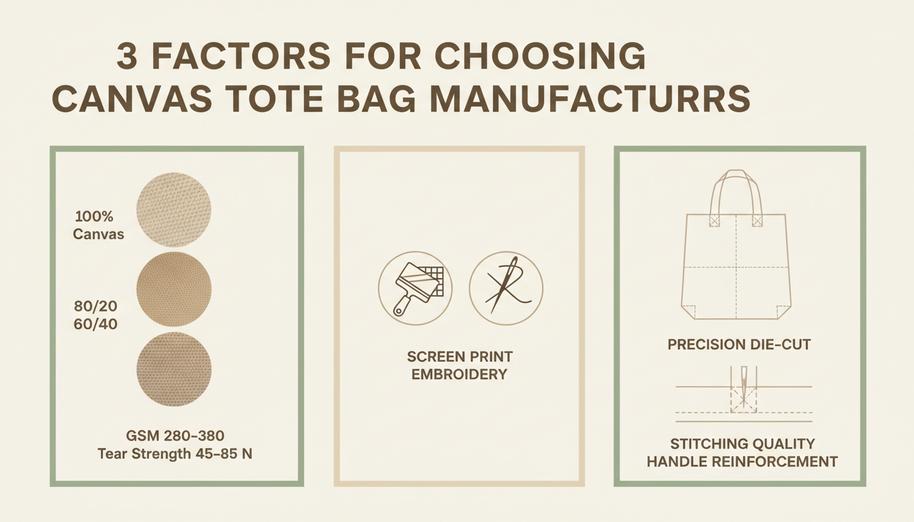
Premium Canvas & Linen Blend for Strength
- Canvas + Linen Blend choices follow weight and feel
- tighter Textile weave changes drape
- better-defined fibers clarify Durability tests
- Fiber mix ratio belongs in the bill
- Yarn density should match the swatch
- Finishing affects texture and printing
A quick comparison used by some canvas tote bag manufacturers:
| Material Mix | GSM Range | Tear Strength (N) | Use Case |
|---|---|---|---|
| 100% Canvas | 280–320 | 45–60 | Daily use |
| Canvas/Linen 80/20 | 300–340 | 60–75 | Heavy loads |
| Canvas/Linen 60/40 | 320–360 | 70–85 | Premium retail |
| Linen-heavy | 340–380 | 65–80 | Fashion focus |
- Material sourcing
- Fiber grade
- combed vs carded
- Weaving
- tight plain weave
- reinforced edges
- Fiber grade
Topfeel Bag often uses balanced blends; a woven-fabric guide helps separate fiber content from construction before approval.
Versatile Customization Techniques: Screen Printing & Embroidery
- Customization starts from approved artwork
- Screen Printing suits defined spot colors
- Embroidery adds texture and stress
- Printing choices shape visual impact
- Decoration defines perception
- Technique affects cost
- Personalization builds identity
- Design must match fabric behavior
- Method selection flow
- Artwork type
- flat color → screen print
- detailed logo → digital
- Bag material
- thick canvas → embroidery stable
- Order size
- bulk → screen printing efficient
- Artwork type
“Durable print adhesion and repeatable color accuracy remain top concerns for branded textile goods in 2025,” notes a recent Statista consumer goods brief.
Topfeel Bag manages multiple compatible techniques; a screen-print overview helps buyers prepare artwork questions.
Rigorous Die-Cutting and Pattern Making Processes
Short view: clean Die-Cutting, smart Pattern Making, and a disciplined Process support repetition.
Long view: In tote bag manufacturing, pattern accuracy affects seams, material, pockets, and handles. Connect the approved pattern to cutting checks:
- Production chain
- Pattern drafting
- size grading
- seam allowance mapping
- Die setup
- blade alignment
- pressure calibration
- Cutting phase
- batch consistency
- waste control
- Assembly
- stitch alignment
- handle reinforcement
- Pattern drafting
Topfeel Bag keeps these controls tight; record measurement points and tolerances before bulk cutting.
🎨 Unify three approvals: Coordinate canvas or linen, screen printing or embroidery, and pattern cutting.
🧭 Topfeel Bag’s sampling workflow turns a locked brief into a review point. Compare the canvas tote route with the canvas material guide to prepare that three-part approval checklist.
High MOQ Concerns? Flexible Canvas Tote Partners
Working with canvas tote bag manufacturers is easier when sampling, approval, production, and delivery assumptions are written down. Topfeel Bag samples after specification and artwork lock.
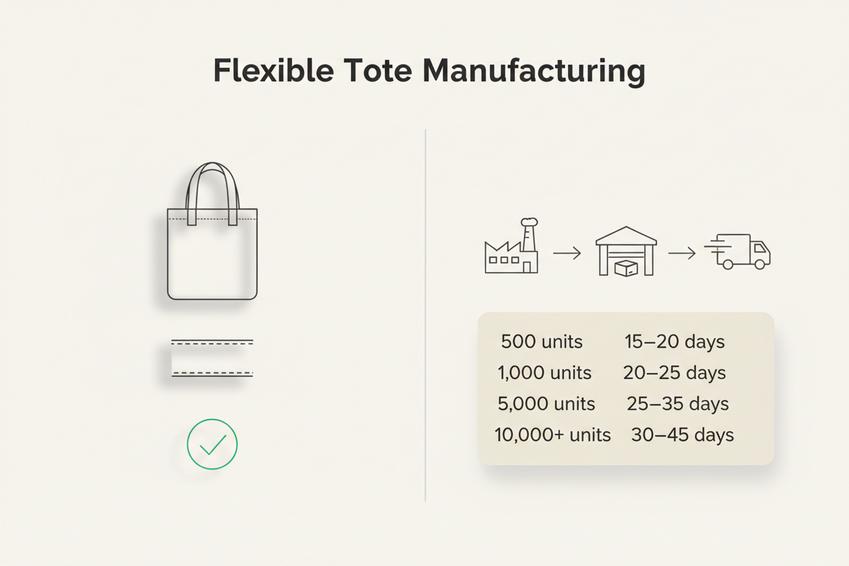
Negotiating Lower Minimums Through Small-Batch Prototyping
When dealing with canvas tote bag manufacturers, start with a focused prototype.
- Start with sample production to validate structure and stitching
- Refine through controlled design iteration rounds
- Lock in material selection before scaling
Then move deeper:
- Prototype phase
- a. Run agreed quality testing on intended use points
- b. Adjust specs for customization before approval
- Feedback loop
- a. Align revisions with product development goals
- b. Close open decisions before bulk production
Some canvas tote manufacturers use sample approval as the scaling gate. Topfeel Bag states 7–10 days after spec and artwork confirmation with stock materials.
Flexible Mass Production & Assembly Options
Scaling up with the right canvas tote bag manufacturers should follow the approved sample.
Here’s how flexibility plays out:
| Order Size | production capacity | Avg lead time management | Cost Efficiency |
|---|---|---|---|
| 500 units | Medium | 15–20 days | Moderate |
| 1,000 units | High | 20–25 days | Improved |
| 5,000 units | Very High | 25–35 days | Strong |
| 10,000+ | Maxed | 30–45 days | Optimal |
Behind that table:
- Adaptive manufacturing processes keep construction visible
- Streamlined assembly lines support checkpoints
- Smart supply chain management controls changes
Topfeel Bag keeps lines modular and documents about 25 days for 1,000 pieces, 30–35 for 6,000, and 35–40 for 10,000; confirm final scope.
Warehousing, Packaging, and Distribution Support
Once production wraps, backend planning should already be agreed.
A clean flow looks like this:
- Storage
- Organized warehousing solutions with records
- Real-time inventory management and release instructions
- Finishing
- Custom packaging design approved early
- Accurate labeling services checked to order
- Shipping
- Coordinated logistics coordination and handoffs
- Reliable distribution networks and destinations
- Fast fulfillment services with dispatch records
Short version? Treat packing, labeling, release, and shipping documents as part of the specification.
🚀 Scale from an approved baseline: The small-batch prototyping baseline can govern mass production, assembly, warehousing, packaging, and distribution. Topfeel Bag typically samples in 7–10 days after the specification and artwork are locked with stock materials.
📋 Use the tote bag program to prepare the scale-up brief, then share it with Topfeel Bag for sampling and production discussion.
References
- EU Ecolabel – Clothing and Textiles — European Commission
- Materials Market Report 2024 — Textile Exchange
- ISO 9001:2015 — ISO
- GOTS Key Features — Global Standards
- Due Diligence Guidance for Garment and Footwear Supply Chains — OECD
- Sustainability and Circularity in the Textile Value Chain — United Nations Environment Programme
- Textiles: Material-Specific Data — U.S. Environmental Protection Agency


.png)



4th-5th Floor, Building B2, Yin Tian Industrial Park, Xi Xiang Road, Bao'an Dist, Shenzhen, 518102 ,China