
 English
  Korean
  French
  German
  Hungarian
  Japanese
  Russian
How to Choose the Right Makeup Bag Supplier for Your Beauty Brand
Your makeup bag supplier protects a launch when late shipments, quality, and specifications are controlled.
Topfeel Bag documents sampling, QA, packing, and shipping.
Compare candidates against one brief.
Quick Insights for the Perfect Makeup Bag Supplier
- Vet Delivery Speed: Compare express vs. standard freight, track shipments in real time, and factor Incoterms into landed costs.
- Balance MOQ & Costs: Negotiate flexible OEM/ODM terms, use phased bulk runs, and forecast demand to manage inventory.
- Ensure Quality Compliance: Review AQL inspection results, verify CE/ISO certifications, and test materials (polyester, canvas, PU leather).
- Customize with Confidence: Assess logo printing, embroidery, hardware finish, and factory prototyping precision before mass production.
- Scale Seamlessly: Audit factory capabilities, streamline cutting–stitching workflows, and plan global shipping, customs clearance, and warehousing.
78% Of Brands Vet Suppliers By Delivery Speed
Delivery affects launches; compare dispatch, tracking, and support.
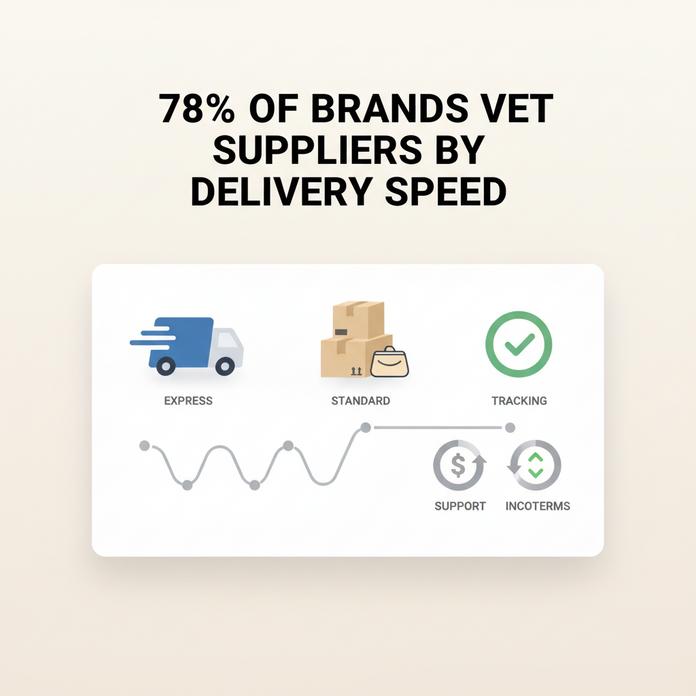
Evaluating Shipping Times: Express vs. Standard Freight
When choosing between shipping methods, compare transit time, production readiness, cost, and schedule risk.
- Core comparison
- Express freight
- Short transit time
- Higher cost, tighter logistics planning
- Standard freight
- Longer lead time
- Budget-friendly, broader freight options
- Express freight
- Decision flow
- Confirm production readiness
- Match transportation modes to destination urgency
- Lock shipment window with your makeup bag supplier
Topfeel Bag quotations should separate production and freight assumptions.
Tracking & Container Loading Efficiency
Define shipment tracking, carton data, loading responsibility, and reporting.
- Loading strategy
- Space optimization
- Stack planning improves loading efficiency
- Reduces breakage in cargo handling
- Warehouse alignment
- Sync warehouse processes with outbound schedules
- Improve supply chain visibility
- Space optimization
- Tracking loop
- Activate real-time scans
- Share milestone updates
- Adjust logistics operations if delays pop up
Topfeel Bag reporting should match warehouse receiving and launch allocation.
Expedited Shipping Costs and Incoterms Impact
Expedited freight changes cost and schedule exposure. Use the official Incoterms rules to record the named place, rule version, tasks, costs, and risk transfer agreed by both parties.
- Cost + responsibility map
- Under Incoterms rules
- FOB: buyer handles freight
- DDP: supplier covers end-to-end
- Impacts
- Customs regulations timing
- risk management clarity
- Under Incoterms rules
- Quick steps
- Pick trade terms
- Estimate total landed cost
- Align with supplier commitments
The supplier prices freight, duties, insurance, and clearance.
Real-Time Delivery Tracking & After-Sales Support
Agree on milestones, evidence, owners, and response times.
- Service stack
- Live delivery updates
- Clear communication protocols
- Fast issue resolution
- After-sales rhythm
- Monitor shipment visibility
- Handle claims or returns
- Protect client satisfaction
Topfeel Bag shipment exceptions should follow the service agreement.
🚚 Make delivery choices visible: Compare production milestones, freight mode, tracking, and exception ownership as one launch plan. Topfeel Bag documents sampling at about 7–10 days after specification lock with stock materials, giving buyers a concrete planning input.
🧭 Explore toiletry bag formats to prepare a product-and-timing brief before requesting a schedule.
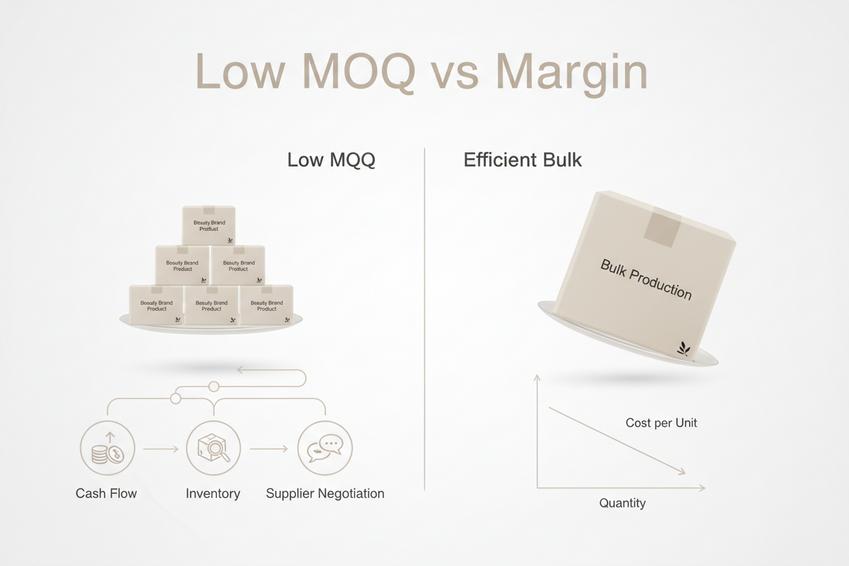
Why Low MOQ Frustrates Growing Beauty Brands
MOQ affects unit economics, cash flow, storage, and demand risk. Compare the minimum for the exact style, material, and process.
Balancing Batch Size with Bulk Production Costs
Unit cost shifts with materials, setup allocation, production efficiency, and manufacturing overhead.
- Core cost dynamics
- Raw materials
- Larger orders unlock economies of scale
- Smaller batches raise per-unit fabric and zipper costs
- Factory operations
- Setup time spreads thinner across big runs
- Short runs increase production planning complexity
- Raw materials
- Cost optimization path
- Analyze break-even points tied to cost optimization
- Adjust batch sizes without breaking supply chain management flow
- Partner with flexible players like Topfeel Bag to test hybrid production runs
Low MOQ decisions should separate development costs from recurring unit costs.
Negotiating OEM/ODM Terms for Flexible Order Quantities
Flexible terms start with a precise specification and staged commercial plan.
- Sample-first agreements reduce upfront risk
- Shared material sourcing lowers entry barriers
- Split production cycles balance manufacturing flexibility
A practical flow:
- Start with small-batch product development
- Lock in supplier agreements for scale-up tiers
- Use staggered contracts to improve vendor relations
Topfeel Bag lists a standard MOQ of 1,000 cosmetic bags per style; special materials or processes generally raise it to 5,000 pieces.
Build flexibility through recorded approval, change-control, and cancellation points.
Inventory Management Solutions to Offset High MOQs
Use inventory optimization to compare sales, storage, replenishment, and obsolescence.
- Inventory control layers
- Demand side
- Use demand forecasting tools to avoid overstock
- Align launches with real sales velocity
- Storage side
- Mix short-term and long-term warehousing strategies
- Monitor storage costs vs reorder frequency
- Demand side
- Fulfillment strategy stack
- Tier 1: Central warehouse (stock control)
- Tier 2: Regional distribution (supply chain logistics)
- Tier 3: Direct-to-consumer shipping (fulfillment strategies)
An experienced supplier should model MOQ, landed cost, inventory, and risk.
Set reorder triggers before bulk approval.
📊 Build a workable order tier: Balance batch cost, OEM/ODM terms, and inventory exposure before committing. Topfeel Bag’s standard cosmetic-bag MOQ is 1,000 pieces per style, while special materials or processes generally move the minimum to 5,000.
🧵 Review makeup clutch constructions, choose a feasible specification, and submit your volume and launch assumptions for an OEM/ODM discussion.
5 Steps To Evaluate Your Makeup Bag Supplier
Evaluate every candidate with one evidence checklist covering samples, quality, materials, customization, and factory documentation.
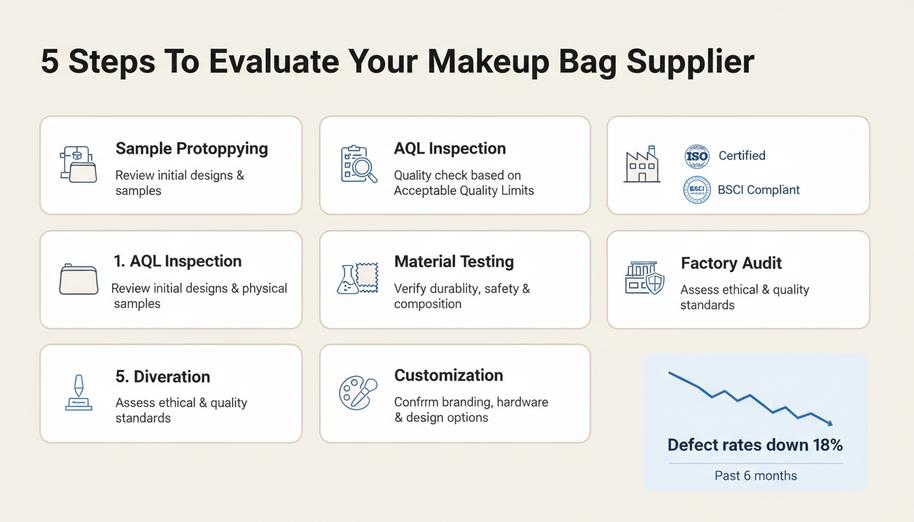
Step 1: Sample Development and Prototyping Review
A controlled sample stage creates the baseline for bulk production.
- Core checks:
- Sample approval
- Prototype evaluation
- Specification adherence
- Deeper review flow:
- Design alignment
- Mock-up accuracy
- Stitching and structure
- Material validation
- Material samples vs bulk stock
- Iteration control
- Design iteration speed
- Pre-production samples consistency
- Design alignment
Tie approval to the specification and revisions.
Step 2: Quality Inspection, AQL Standards & Defect Rate Testing
Quality requires defined defects and corrective action. ISO’s AQL sampling page identifies the 1999 edition as withdrawn and a 2026 replacement.
“Brands tightening supplier quality protocols saw defect rates drop by over 18% in 2025 global sourcing reviews.” — McKinsey sourcing insights, 2025
- Inspection hierarchy:
- Incoming materials
- Testing procedures
- In-line production
- Defect classification
- Final shipment
- Inspection reports
- Incoming materials
- Control metrics:
- AQL levels
- Acceptance criteria
- Statistical sampling
Repeated non-conformance requires root-cause review and closure.
Step 3: Material Testing for Polyester, Canvas & PU Leather
Test methods must match material, construction, and use. ASTM publishes grab breaking strength and falling-pendulum tear methods; neither alone proves finished-bag durability.
- Performance layers:
- Durability
- Tear strength, abrasion resistance
- Environmental resistance
- Water resistance, colorfastness
- Composition accuracy
- Material composition, chemical testing
- Durability
- Breakdown by fabric:
- Polyester → confirm weight, coating, and woven construction
- Canvas → confirm fiber content, fabric thickness, and construction with a canvas material guide
- PU → flexible, premium feel
Require the specimen, method, and result.
Step 4: Assessing Customization Features—Logo Printing to Embroidery
Approve branding on the intended substrate; the screen-print process shows why artwork, ink, and surface preparation matter.
- Customization stack:
- Surface branding
- Printing techniques, heat transfer
- Premium finishes
- Embroidery options, debossing
- Functional details
- Zipper pulls, hardware customization
- Labeling
- Surface branding
- Consistency check:
- Batch-to-batch color match
- Logo placement precision
Topfeel Bag documents multiple logo processes, subject to material compatibility.
Step 5: Factory Audit, Certifications & Compliance Check
Trust is verified by certificate owner, site, scope, issuer, and validity. ISO’s quality-management family includes ISO 9001, while CE marking identifies conformity responsibilities for products.
- Audit structure:
- Compliance
- Regulatory compliance, social compliance
- Operations
- Factory capacity, audit reports
- Responsibility
- Worker safety, ethical sourcing
- Environmental standards
- Compliance
- Certification signals:
- Certifications (e.g., ISO, BSCI)
- Process transparency
- Documentation clarity
Use the ILO’s occupational safety and health guidance when assessing worker-safety systems. Topfeel Bag states that corporate certifications are available on request; confirm their scope for the relevant entity and facility.
🔍 Evaluate the whole supplier: Coordinate sample approval, quality inspection, material evidence, customization standards, and factory compliance before bulk release.
🛡️ Topfeel Bag’s workflow moves from specification through sampling, PP-sample approval, in-process QC, bulk production, and final QA. Compare train-case constructions to decide which structural details belong in the approval file.
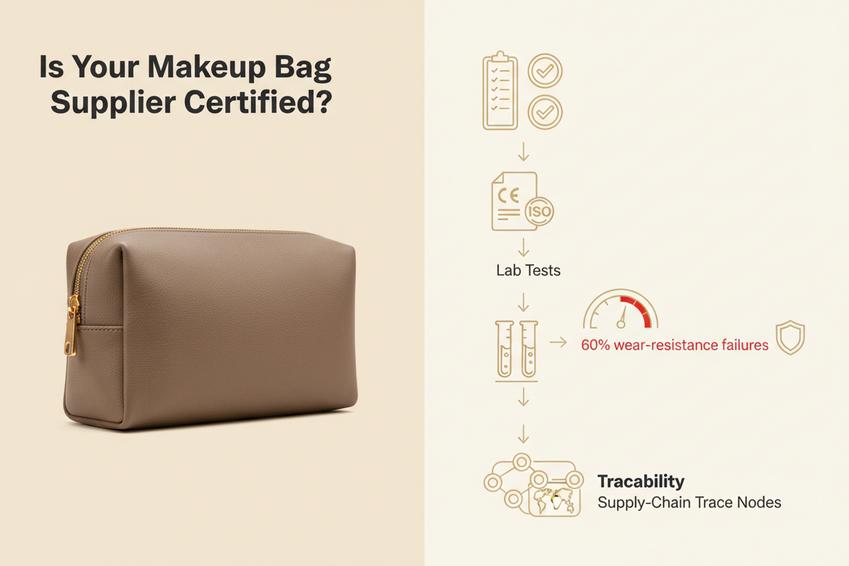
Is Your Makeup Bag Supplier Truly Certified?
Certification, testing, and traceability records should match the product, facility, and destination.
Verifying Compliance: CE, ISO and Material Testing Reports
Supplier paperwork should map applicable rules to product claims.
- Certification review
- Compliance
- Check valid CE certification
- Confirm updated ISO certification
- Regulatory compliance
- Match destination market rules
- Cross-check expiry dates
- Compliance
- Material testing
- Material testing
- Fabric toxicity reports
- Chemical limits validation
- Test reports
- Lab-issued, not self-declared
- Batch-specific documentation
- Material testing
Keep each document connected to a requirement in the controlled specification.
Durability Testing: Stitch Strength, Colorfastness & Hardware Finish
Product-specific durability testing should reflect foreseeable handling, loading, cleaning, and storage.
A solid makeup bag supplier should show:
- Stitch strength results under load
- Colorfastness after repeated washing
- Hardware finish resistance to scratches
Short checks still matter:
Tight seams. Smooth zippers. No fading drama.
“Post-2024 sourcing audits show over 60% of soft goods failures come from poor wear resistance rather than design flaws.” — global sourcing insight, 2025
Test for product longevity through laboratory, sample, and in-process controls.
Traceability of Bag Components—Zippers, Linings & Interlining
Traceability connects approved components to purchase, production, and shipment records. The CPSC explains tracking-label requirements for children’s products; apply them only when the product falls within scope.
Step flow:
- Map component traceability
- Identify zippers, linings, interlining sources
- Verify raw material sourcing
- Record component origin
- Maintain supply chain transparency logs
Topfeel Bag’s sequence records cutting, reinforcement, finishing, hardware installation, PP inserts where needed, forming, inspection, and packing.
Third-Party Inspection vs. In-House Quality Assurance
In-house control supplies feedback; independent inspection adds an external checkpoint.
- Quality assurance system
- In-house quality control
- Daily verification procedures
- Real-time fixes
- Quality management
- Staff training loops
- In-house quality control
- Independent validation
- Third-party inspection
- Neutral inspection standards
- Random sampling
- Supplier auditing
- Factory-wide checks
- Third-party inspection
Define scope, sampling, defect classes, reporting, and escalation for both layers.
Comparative: Domestic Vs. Overseas Suppliers
A makeup bag supplier’s location changes freight, communication, oversight, duties, and market familiarity, but not quality by itself.
Domestic Suppliers
Domestic sourcing may shorten travel and communication, while lead times, capacity, and quality control still vary. The FTC’s Made in USA standard governs unqualified US-origin claims, so location and origin wording require separate evidence.
- Quick perks you’ll notice:
- Faster shipping
- Clearer communication
- Easier regulatory compliance
- Start with a nearby bag supplier shortlist
- Request samples to test quality control
- Confirm timelines and intellectual property safeguards
Now, zoom in a bit:
- Operations flow
- Sourcing
- Local material access tied to cultural understanding
- Production
- Easier audits improve quality control
- Delivery
- Reduced lead times due to shorter shipping
- Sourcing
Compare domestic candidates with identical specification, inspection, and service criteria.
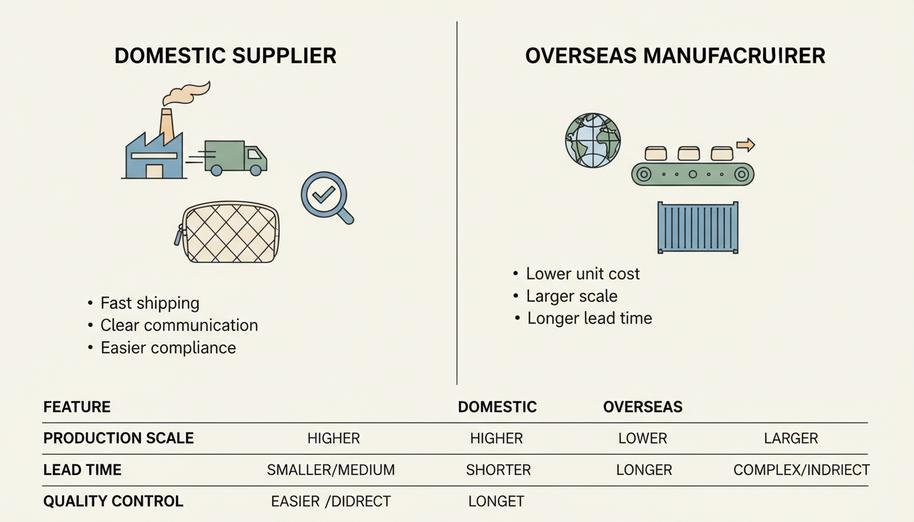
Overseas Suppliers
Overseas production may offer different economics or production scale, but buyers must account for border formalities and longer recovery paths.
Here’s how the numbers usually stack up:
| Factor | Domestic Supplier | Overseas Supplier | Impact Level |
|---|---|---|---|
| Unit Cost | High | Low | High |
| Lead Time | Short | Long | Medium |
| Production Scale | Limited | Extensive | High |
| Communication | Easy | Communication Challenges | Medium |
- Process breakdown:
- Supplier selection
- Evaluate specialized expertise
- Check ethical sourcing
- Production phase
- Monitor quality assurance
- Manage supply chain complexity
- Delivery stage
- Handle customs & duties
- Plan longer shipping
- Supplier selection
Reality check: the OECD’s garment and footwear due-diligence guidance provides a risk-based framework. Use it with commercial, quality, and logistics evidence rather than treating origin as a proxy for performance.
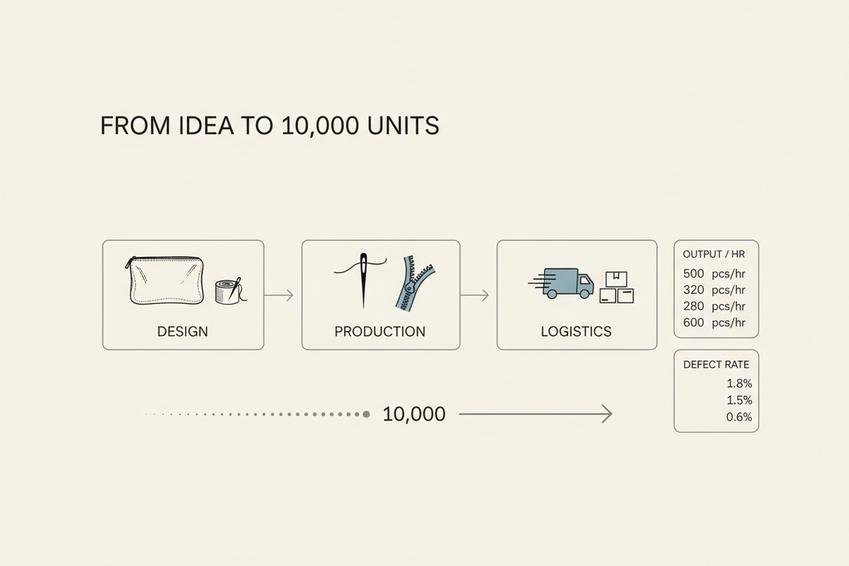
Scenario: Scaling From 1 Campaign To 10k
Moving from one campaign to 10,000 units requires controlled specifications, approved samples, stable production stages, and a logistics plan.
Design Assistance & Custom Lining for High-Volume Launches
Use design consultation to lock choices that affect both appearance and construction.
- Core flow
- Concept alignment
- material selection tuned for durability and feel
- custom patterns matched to brand identity
- Build validation
- prototyping rounds with quick tweaks
- sample approval before scaling
- Finish details
- lining options that balance aesthetic and functionality
- Concept alignment
A zipper pull or lining change affects procurement, tooling, and inspection. Compare velvet and velveteen and review what velvet is made of when specifying lining.
Streamlining Mass Production: Cutting, Stitching & Assembly Workflow
Once the design is locked, connect the approved sample to records at every production stage.
- Cutting stage
- cutting techniques calibrated for fabric type
- Stitching stage
- stitching methods aligned with stress points
- Assembly stage
- assembly line balance to reduce idle time
Quality doesn’t sit at the end. It runs through:
- inline quality control checks
- tracked manufacturing capacity
- realistic lead time targets
| Stage | Avg Output/hr | Defect Rate |
|---|---|---|
| Cutting | 500 pcs | 1.2% |
| Stitching | 320 pcs | 1.8% |
| Assembly | 280 pcs | 1.5% |
| Final QC | 600 pcs | 0.6% |
Topfeel Bag documents multi-needle sewing, reinforcement at stress points, and final inspection and packing.
Global Shipping, Customs Clearance & Warehousing Strategy
Build the import plan before production finishes.
- Logistics chain
- logistics planning synced with production
- international shipping mode selection
- air for speed
- sea for cost
- Border handling
- clean customs documentation
- updated import regulations tracking
- Storage + reach
- flexible warehousing solutions
- smart distribution network
Record document ownership, broker handoff, charges, receiving, and exceptions. US CBP publishes importer and exporter tips covering importing responsibilities and common preparation steps.
🎯 Scale with controlled handoffs: Design, production, and logistics decisions need one specification and approval trail.
🏭 Topfeel Bag connects brief, 7–10-day sampling after spec lock with stock materials, PP-sample approval, in-process QC, bulk production, final QA, and shipping. Explore handheld bags to define a scalable construction, then submit campaign volume, destination, artwork, and timing for review.
References
- Incoterms® rules — International Chamber of Commerce
- ISO 2859-1 sampling procedures — ISO
- Breaking Strength of Textile Fabrics — ASTM International
- Tearing Strength of Fabrics — ASTM International
- ISO 9000 family — Quality management — ISO
- CE marking — European Commission
- Safety and health at work — International Labour Organization
- Tracking Label Business Guidance — U.S. Consumer Product Safety Commission
- OECD Due Diligence Guidance for Garment and Footwear Supply Chains — OECD
- Complying with the Made in USA Standard — Federal Trade Commission
- Importer and Exporter Tips — U.S. Customs and Border Protection


.png)



4th-5th Floor, Building B2, Yin Tian Industrial Park, Xi Xiang Road, Bao'an Dist, Shenzhen, 518102 ,China