
 English
  Korean
  French
  German
  Hungarian
  Japanese
  Russian
How to Vet Quality Sling Bag Manufacturers for Your Startup
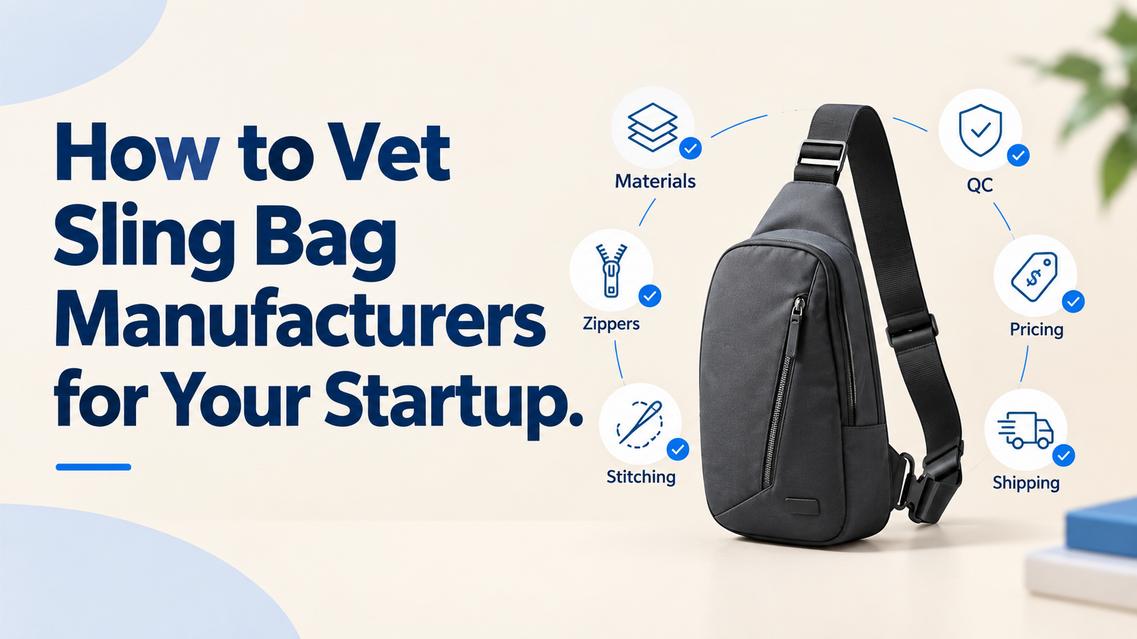
Choosing sling bag manufacturers can feel like a high-stakes first date: a sample may look sharp while bulk production exposes weak seams or delays.
Topfeel Bag’s guidance emphasizes custom materials, hardware, sampling, and quality control.
Smart vetting checks stitching, water resistance, testing, pricing, packaging, and shipping before the PO.
Reading Notes: Sling Bag Manufacturers Essentials
- Audit Materials & Hardware: Verify canvas specs, leather grades, zippers, buckles, and rivets early.
- Evaluate Processes & QA: Inspect stitching, cutting, embroidery, zipper durability, color fastness, and load tests.
- Compare Costs & Logistics: Itemize printing, accessories, prototype, audit, lead-time, and MOQ.
Why Vet Sling Bag Manufacturers Early?
Early vetting catches issues before sampling or bulk orders. Compare materials, sewing controls, and readiness for dependable scaling.
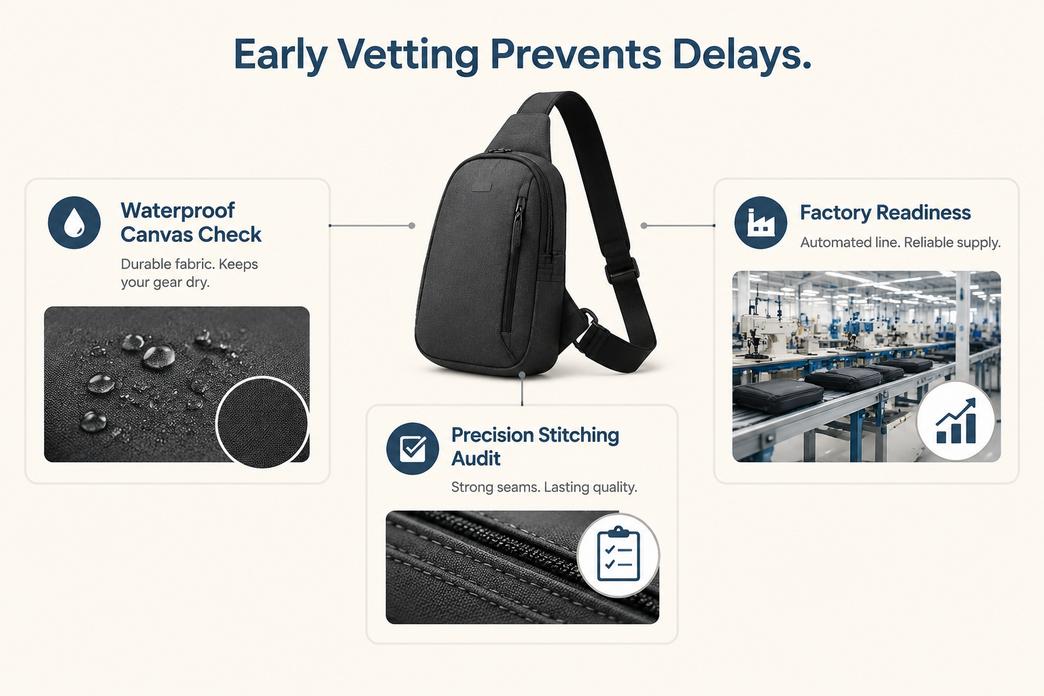
Prevent Material Surprises with Waterproof Canvas Checks
A bag can look right while hiding weak performance. Before approval, check the actual raw material, not only the supplier description. Use what canvas is made of to keep the brief precise.
- Material proof
- Review fabric weight, fiber content, and coating inspection records for chosen waterproof canvas.
- Request fabric testing for the production material lot.
- Water performance
- Check the hydrostatic head test, which measures water pressure before leakage.
- Compare results with intended use and required material durability.
- Approval
- Record accepted specifications as the textile quality benchmark for prototypes and bulk goods.
Ensure Process Consistency through Precision Stitching Audits
Good sewing needs repeatability, not one tidy sample. Review precision stitching across several units and runs. A strap inspection guide highlights stress points.
- Measure stitch density at main seams.
- Check reinforced handles, zipper ends, and load points for seam strength.
- Review needle tension for loose threads or puckering.
- Use a documented quality audit to compare prototype and bulk workmanship. A sewn-seam failure method gives teams a formal reference for seam evaluation.
Avoid Production Delays by Verifying Automated Production Lines
Factory readiness matters as orders climb. Use a woven-fabric guide when translating a design into capacity.
- Capacity and workflow
- Inspect automated production lines and confirm realistic output.
- Map the production workflow from cutting through final inspection.
- Resources
- Conduct machinery verification for needed equipment.
- Review staffing, maintenance, and equipment reliability.
- Scheduling
- Match factory capacity with orders and expected lead time.
- Ask Topfeel Bag how peak-season demand affects manufacturing efficiency.
🧭 Start with evidence: Early vetting works when material approval, stitching consistency, and production capacity sit in one decision brief. Topfeel Bag uses industrial multi-needle sewing with reinforced X-stitches at vulnerable points, giving buyers a concrete checkpoint.
Explore the crossbody bag range and outdoor bag category to decide which construction notes and capacity requirements belong in your sample brief.
5 Steps to Audit Your Maker
Auditing sling bag manufacturers means checking details that affect cost, lifespan, and returns. Move from materials to packing for a fair comparison.
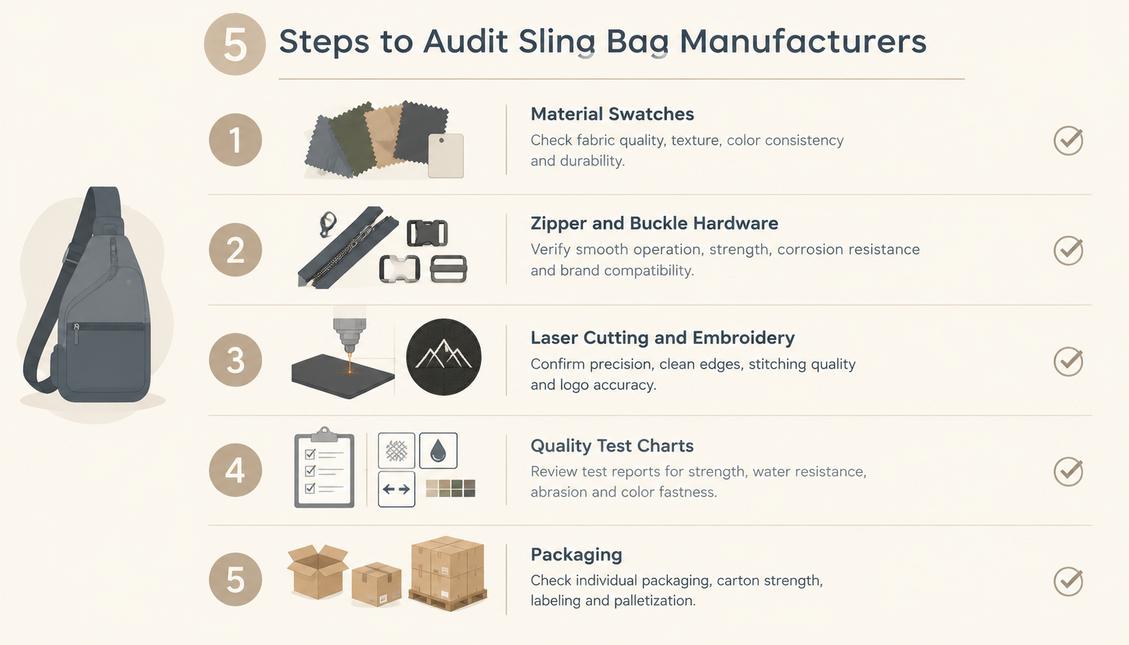
Step 1: Assess Material Specs – Nylon Fabric & PU Leather
Start with the approved material swatch, not a description. For fabric strength, the ASTM grab-test method is clearer than an unqualified claim.
- For nylon fabric:
- Confirm denier rating, weave, and fabric thickness.
- Match tensile strength to expected loads.
- Check the water repellent coating against the sample.
- For PU leather:
- Measure thickness and surface consistency.
- Balance durability with the target sling bag price.
Document these points before bulk cutting. If a supplier cites a textile label, check scope on the OEKO-TEX STANDARD 100 page rather than treating a logo as finished-bag proof.
Step 2: Inspect Hardware Accessories – Metal Zipper & Plastic Buckle
Run the metal zipper repeatedly and inspect its alloy slider and electroplating finish. Check the plastic buckle too: POM material generally suits parts needing strength and repeated flexing. Use PP plastic basics to keep polymer terminology consistent.
A pull force test can expose weak attachments. Inspect snap hooks, pullers, magnetic snaps, and rivets.
Step 3: Evaluate Manufacturing Processes – Laser Cutting & Custom Embroidery
- Check laser cutting:
- Clean dimensions.
- Consistent edge sealing.
- Review custom embroidery:
- Compare stitch density with approved artwork.
- Look for steady thread tension and needle precision.
- For printed decoration:
- Confirm the heat press, heat transfer, or screen-print result stays within design tolerances. Review the screen-print process when choosing a control point.
Assess Topfeel Bag against these checkpoints. For chemical input documentation, discuss the OEKO-TEX ECO PASSPORT framework within supplier scope.
Step 4: Verify Quality Assurance – Zipper Durability & Color Fastness Tests
- Request zipper durability and fatigue test records.
- Verify color fastness with a crock test where applicable. Use the AATCC test-method directory to identify a relevant method.
- Review abrasion resistance, water resistance, and load bearing results.
- Confirm routine quality inspection covers stitch density. The AATCC colorfastness module helps align terminology before reviewing records.
Repeatable records matter more than a perfect sample.
Step 5: Confirm Logistics Packaging – Polybag Sealing & Pallet Packing
- Check polybag sealing:
- Add a desiccant pouch when humidity risk calls for it.
- Confirm suitable moisture protection.
- Review cartons:
- Verify carton dimension and weight limits.
- Match each barcode label and shipping mark to the order.
- Inspect pallet packing:
- Cartons should remain stable through handling and freight. For overseas orders, use CBP importing basics and tips for new importers before booking freight.
🔍 Ready for a complete audit?
A useful five-step review connects the material swatch, hardware attachment, decoration controls, test records, and packing handoff. Topfeel Bag’s production flow ends with 100% inspection and packing, so the audit can follow the product from cutting through dispatch. See the accessory bag collection and crossbody bag range, then request a sample discussion with your material, testing, and packing requirements.
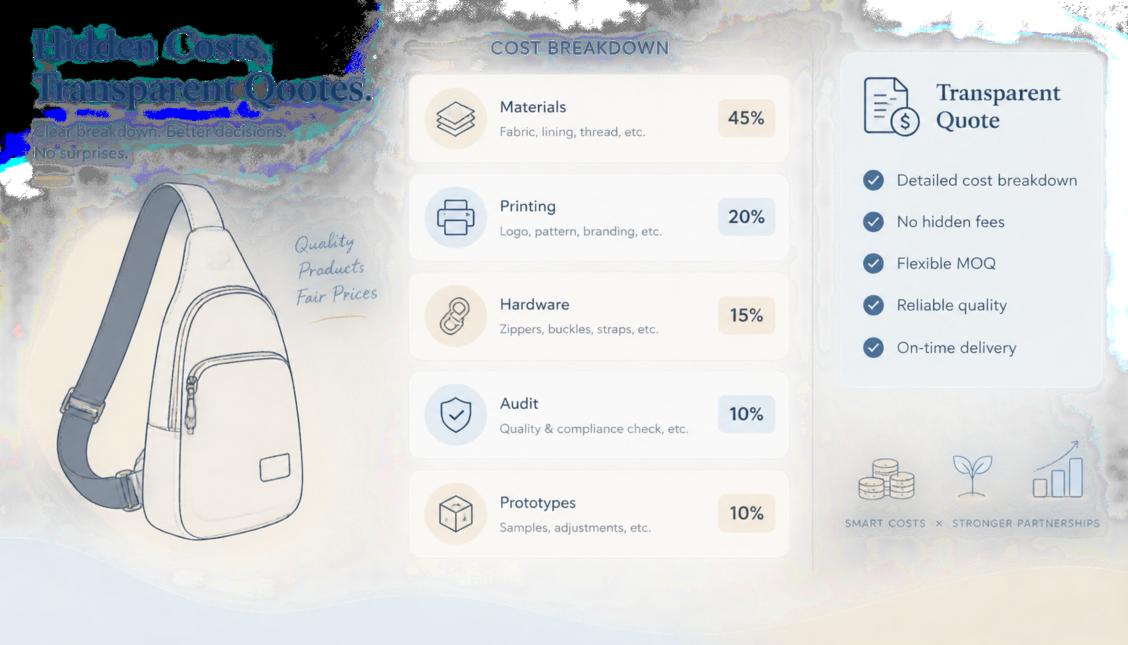
Hidden Costs Biting Margins? Transparent Quotes Now.
Getting a clean quote requires more than unit price. Materials, printing, hardware, audits, and prototypes can push a deal over budget. Break charges apart.
Material Specs Breakdown: Genuine Leather vs. Polyester Lining
Ask suppliers to identify leather and lining details rather than writing only “genuine leather.”
- Leather
- Specify top-grain leather, hide grading, thickness, and the tanning process.
- Confirm cutting yield because scars and irregular hides increase consumption.
- Lining
- Record the synthetic fiber type and fabric density.
- Request tensile strength and abrasion resistance targets where durability matters.
That detail keeps material comparisons consistent. A fabric-thickness reference can help define swatch requirements.
Heat Transfer Printing Price Factors Uncovered
Printing prices rise when artwork is larger or more complex.
- Give sling bag manufacturers the artwork dimensions, quantity, colors, and placement.
- Ask how substrate preparation, thermal adhesion, pigment foil, release liner, and cure temperature affect setup and unit charges.
- Compare heat transfer against a screen matrix process. At higher volumes, screen printing may reduce cost, although tight color registration can add setup work.
Accessory Fee Insights for Alloy Puller & Brass Rivet
Hardware deserves its own cost bucket.
- Pullers
- Confirm zinc alloy grade and die-casting mold charges.
- Separate custom logos from standard designs.
- Rivets
- Check fastener hardware specifications and required structural integrity.
- Finishes
- Price galvanic plating, surface finishing, and corrosion resistance separately.
Buyers can use this breakdown when comparing accessory MOQs.
Factory Audit & Prototype Development Charge Overview
- Confirm audit costs covering compliance verification, labor standards, production capacity, and machinery capability. The WTO technical-barriers overview helps check market-specific requirements. Use the Incoterms® 2020 rules to state transport ownership.
- Define prototype fees for sample realization, revisions, and pattern grading.
- Add testing, tooling, OEM or ODM design work, plus agreed quality assurance checks.
- Ask sling bag manufacturers which sampling or development charges become refundable or credited once the production order reaches the required quantity.
💡 Make every fee explainable: Separate material, decoration, hardware, audit, and prototype charges. Topfeel Bag supports custom size and swatch color matching; explore the cosmetic bag category to prepare one comparable spec sheet.
Domestic vs. Overseas Manufacturers
Choosing between local and global factories comes down to more than price. Weigh speed, oversight, order size, sourcing risk, and coordination before selecting a growth-ready partner.
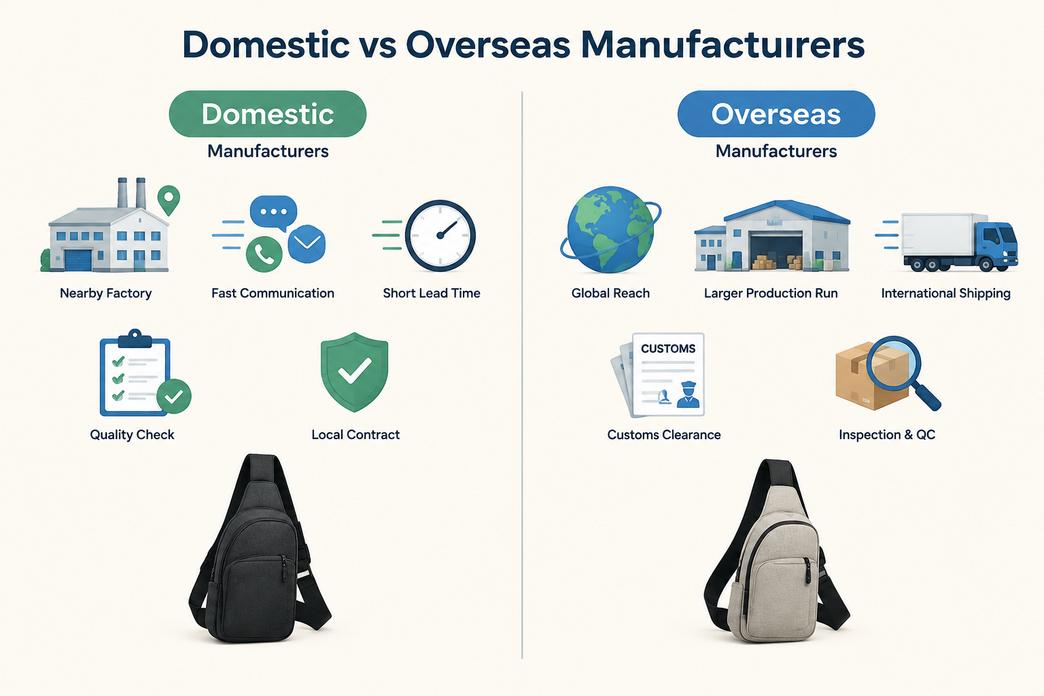
Domestic Manufacturers
Domestic production helps when quick decisions and close oversight matter.
- Development and operations
- communication is usually faster when working hours overlap.
- A shorter lead time can help brands restock popular bags.
- A practical factory visit lets buyers check stitching, materials, and methods in person.
- Cost and protection
- Local labor may raise unit prices, but lower shipping cost can narrow the gap.
- Hands-on quality control helps catch zipper, seam, or strap problems early.
- Familiar regulatory compliance rules can simplify documentation.
- Clear local contracts may make intellectual property easier to protect.
Topfeel Bag can also be considered when sourcing extends beyond the local market. A tote bag definition can clarify a daily-carry comparison.
Overseas Manufacturers
Overseas production can suit larger runs, competitive costs, or wider OEM and ODM choices, with more cross-border coordination.
- Production planning
- Check production capacity against expected monthly demand.
- Confirm sample approval, MOQ, material sourcing, and the wider supply chain before bulk production.
- Quality management
- A language barrier can lose small specifications, so technical sheets should be precise.
- Arrange a third-party inspection before final payment or shipment.
- Delivery planning
- Review applicable import regulations before production finishes.
- Use an experienced freight forwarder for routing and shipment documents.
- Prepare paperwork early for customs clearance.
🌍 Turn location into a plan: Domestic and overseas sourcing need one record for capacity, oversight, risk, and delivery ownership.
Topfeel Bag’s export-ready production and QC support global brand customers across North America, Europe, Australia, and beyond. Sampling is typically 7–10 days after spec freeze and artwork confirmation. See the handbag category and tote bag route. Request an OEM/ODM sourcing discussion with your target market, order size, and shipping responsibilities.
References
- D5034 Standard Test Method for Breaking Strength and Elongation of Textile Fabrics
- D1683/D1683M Standard Test Method for Failure in Sewn Seams of Woven Fabrics
- Standard Test Methods and Procedures
- Colorfastness Module
- OEKO-TEX® STANDARD 100
- OEKO-TEX® ECO PASSPORT
- Basic Importing and Exporting
- Tips for New Importers and Exporters
- Incoterms® 2020
- Technical Barriers to Trade


.png)



4th-5th Floor, Building B2, Yin Tian Industrial Park, Xi Xiang Road, Bao'an Dist, Shenzhen, 518102 ,China