
 English
  Korean
  French
  German
  Hungarian
  Japanese
  Russian
The Ultimate Guide to Designing Screen Printed Tote Bags
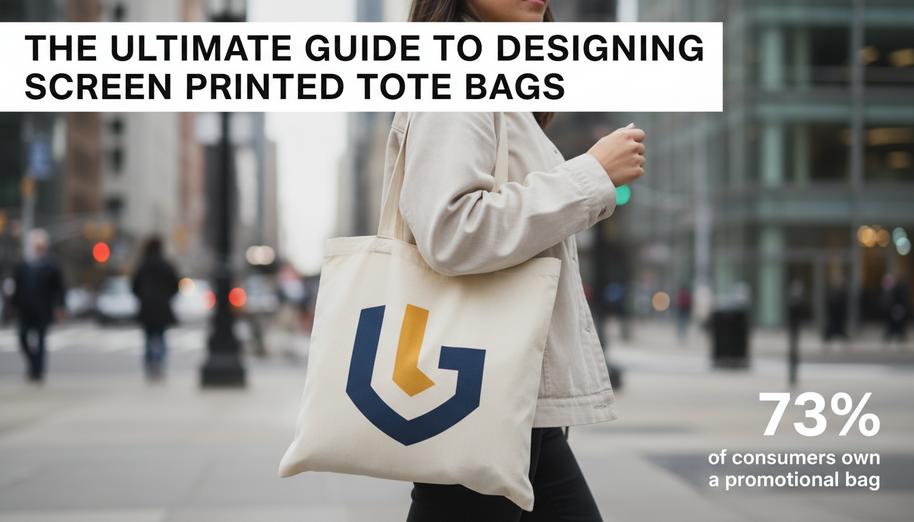
Screen printed tote bags aren’t just freebies tossed across a trade show table—they’re walking billboards with a pulse. One sharp design and your logo is riding the subway, grabbing coffee, hitting the farmer’s market. But here’s the rub: muddy ink, off-center prints, flimsy straps. That’s how brands blow a perfectly good marketing moment.
Promotional Products Association International reports 73% of consumers own a promotional bag—and most keep it for years. That’s not swag. That’s staying power. As marketing legend Seth Godin says, “People do not buy goods and services. They buy relations, stories, and magic.”
This guide cuts straight to what keeps procurement managers up at night: color accuracy, fabric choices, eco-credibility, and bulk orders that don’t go sideways. Because when a tote feels solid and looks sharp, your brand doesn’t just show up—it sticks.
Why Screen Printed Tote Bags Matter For Brands
Screen printed tote bags show up everywhere—campus, trade shows, grocery runs. When your logo rides along on daily errands, brand vibes stick. That’s why smart companies invest in screen printed tote bags.
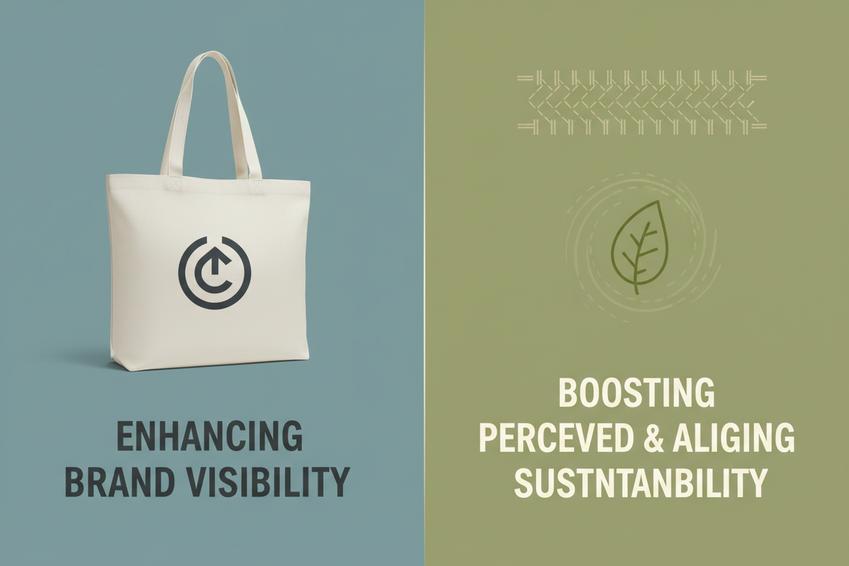
Enhancing Brand Visibility with Screen Printing
Screen printed tote bags turn casual carry into moving ads through:
- Design Layer
- logo placement
- Center chest print for bold design impact
- Corner alignment for subtle visual appeal
- custom graphics
- Event-specific artwork
- Limited-edition drops boosting brand recognition
- color vibrancy
- High-contrast inks
- Pantone-matched shades for sharper design impact
- logo placement
- Exposure Layer
- Daily commute
- Retail shopping
- Campus life
Screen printed tote bags, printed tote bags, and screen print bags all work the same magic: steady impressions without ad spend. A well-placed logo on branded tote bags keeps brand recognition growing naturally. The screen print process ensures that even complex designs remain crisp over hundreds of uses.
Boosting Perceived Value via Durable Zipper Closure & Reinforced Stitching
Quality shifts how people treat screen printed tote bags.
- Construction Core
- zipper closure
- Smooth glide testing (500+ pulls)
- Secure storage for tech or makeup
- reinforced stitching
- Cross-stitched handles
- Stress-point bar tacks
- Heavy canvas body for lasting durability
- zipper closure
- Performance Snapshot
| Feature | Standard Tote | Upgraded Screen Printed Tote Bags |
|---|---|---|
| Handle Load | 5 kg | 12 kg |
| Stitch Count/Inch | 6 | 10 |
| Zipper Cycles | None | 500+ |
| Avg. Lifespan | 6 months | 18+ months |
Longer longevity equals stronger quality construction perception. That’s where Topfeel steps in—delivering functional features that make screen printed tote bags feel premium, not promo. Whether you are designing handbags for retail or accessory bags for a gift set, structural integrity is non-negotiable.
Aligning Sustainability Aspects: Organic Cotton Canvas & Low-Impact Dyes
Eco appeal isn’t hype; it’s buying logic. According to the Environmental Protection Agency, textile waste is a growing concern, making jute fabric material and organic cotton essential for modern brands.
- Material Choice
- organic cotton canvas
- Certified farms
- Reduced pesticide use
- Recycled fabric options for printed tote bags
- organic cotton canvas
- Dye & Process
- low-impact dyes
- Lower water waste
- Cleaner wastewater output
- Energy-aware curing methods
- low-impact dyes
- Brand Impact
- Clear eco-friendly materials messaging
- Transparent sustainable sourcing
- Visible ethical production standards
Consumers choosing screen printed tote bags often look for environmental consciousness. When Topfeel pairs screen printing with jute or other responsible materials, screen printed tote bags become more than merch—they signal values.
3 Key Steps To Perfect Artwork Prep
Getting screen printed tote bags right isn’t just about cool graphics. It’s about prep work that saves money, avoids messy reprints, and keeps your printed tote bags looking sharp in real life. From recycled fabrics to color tuning, this guide walks through how screen print tote bags are refined before bulk production kicks off.
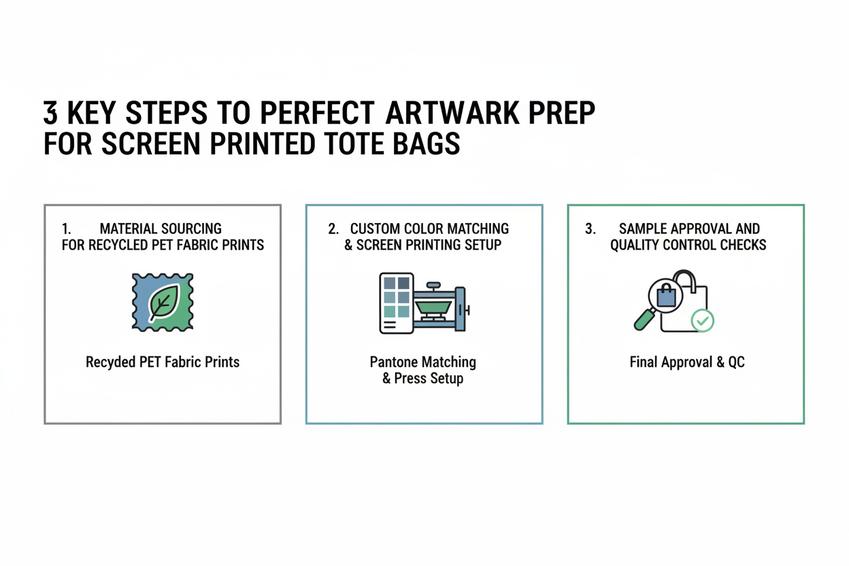
Step 1: Material Sourcing for Recycled PET Fabric Prints
When producing screen printed tote bags, fabric choice quietly decides everything—ink grip, durability, and that smooth retail feel. Understanding what is woven fabric helps designers select the right substrate for high-resolution logos.
- Material Base Evaluation
- Recycled PET fabric
- Source certification (GRS preferred)
- Fiber origin traceability
- Sustainability compliance
- Jute blend alternatives
- Surface roughness level
- Ink adhesion compatibility
- Recycled PET fabric
- Fabric Performance Testing
- Fabric weight
- 120–180 GSM for lightweight printed tote bags
- 200+ GSM for heavy-duty screen print tote bags
- Weave structure
- Plain weave: smoother logo edges
- Twill weave: deeper texture, rustic vibe
- Fabric properties
- Absorption rate
- Shrinkage percentage
- Tensile strength
- Fabric weight
- Material Testing Benchmarks
| Test Item | Standard Range | Impact on Screen Printed Tote Bags |
|---|---|---|
| Fabric Weight (GSM) | 140–220 | Print durability & shape retention |
| Shrinkage Rate | ≤3% | Artwork alignment stability |
| Ink Absorption (%) | 8–15 | Color vibrancy |
| Tensile Strength (N) | ≥250 | Handle strength |
| Colorfastness Grade | 4–5 | Wash resistance |
At Topfeel, material sampling happens before artwork approval, not after. That saves brands from expensive fixes when scaling screen printed tote bags production. Choosing the right thickness of cotton fabric is often the first step in ensuring the ink doesn’t bleed.
Step 2: Custom Color Matching & Screen Printing Setup
Color on screen printed tote bags has zero room for guesswork. Many brands rely on Pantone Matching Systems to ensure global consistency across different factories.
- Color Development Process
- Pantone colors
- Direct Pantone-to-ink conversion
- Brand guideline cross-check
- Ink formulation
- Pigment ratio adjustment
- Binder compatibility with recycled PET
- Ink viscosity
- Thicker ink for bold logo prints
- Thinner blend for gradient tote bag printing
- Pantone colors
- Printing Calibration Control
- Screen mesh count
- 110–160 mesh for solid graphics
- 180+ mesh for fine typography
- Printing press calibration
- Pressure alignment
- Stroke consistency
- Print registration
- Multi-color overlay precision
- Edge-to-edge alignment testing
- Screen mesh count
If your screen printed tote bags show dull reds or fuzzy outlines, it usually traces back to poor mesh choice or unstable viscosity. How does screen printing work effectively is by managing these variables meticulously.
Topfeel’s technicians run small-batch screen printed tote bags trials to confirm color accuracy before mass printing tote bags. That step alone cuts rework rates noticeably.
Step 3: Sample Approval and Quality Control Checks
Before bulk runs of screen printed tote bags start, samples go through layered inspection. Professional manufacturers often follow ISO 2859-1 standards for sampling procedures.
- Artwork & Layout Verification
- Artwork alignment
- Logo centering tolerance within ±2mm
- Handle symmetry check
- Print clarity
- Edge sharpness under magnification
- Ink bleed inspection
- Artwork alignment
- Durability & Structure Testing
- Durability testing
- 500-cycle abrasion test
- 5-wash color retention check
- Fabric integrity
- Seam stress pull
- Handle reinforcement load test
- Durability testing
- Final Production Review
- Color consistency
- Batch-to-batch comparison
- Defect identification
- Pinholes
- Ink cracking
- Misregistration
- Final inspection
- Random AQL sampling
- Packaging cleanliness
- Color consistency
Clean approval means your screen printed tote bags move confidently into full production. This process is equally critical for crossbody bags and toiletry bags where seam strength is tested by daily use.
Avoid Misalignment Errors With Simple Tricks
Getting screen printed tote bags to look clean isn’t luck. It’s about lining up the art with the bag’s build. When printing on tote, screen print tote bags, or custom screen printed tote bags, small shifts can ruin the vibe. Here’s how to keep every print tight and centered.
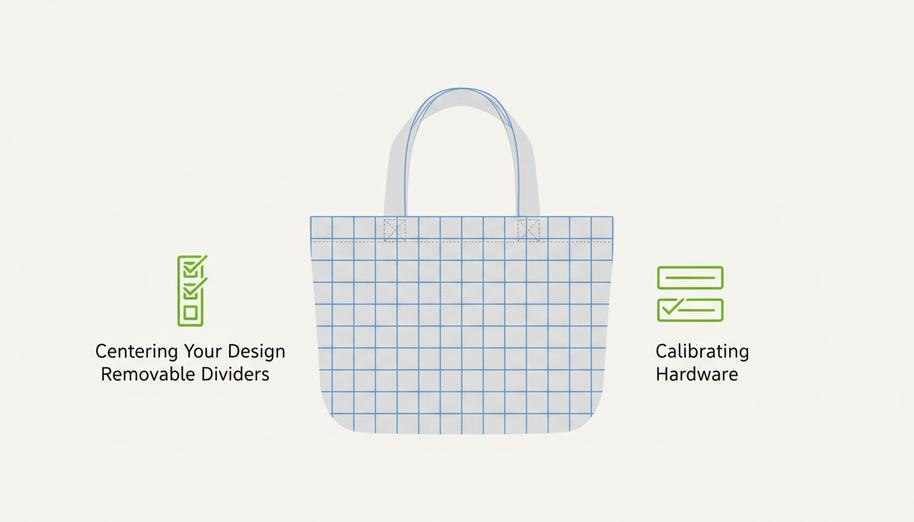
Centering Your Design on the Tote’s Silhouette Shape
For balanced design placement on screen printed tote bags, focus on the bag’s shape before ink hits fabric.
- Understand the frame
- Review the tote bag silhouette
- Check width vs. height
- Note strap drop impact on print area
- Measure true bag dimensions
- Flat lay measurement
- Filled-shape adjustment
- Review the tote bag silhouette
- Build a smart guide
- Create a scaled design template
- Mark a vertical and horizontal centering guide
- Align artwork for clean visual alignment
- Test before production
- Print sample screen printed tote bags
- Compare top margin, side spacing, and pocket interference
When printing tote bags screen printed for retail, the dimensions of a tote bag dictate the maximum print size. Topfeel handles this by mapping every print area to the exact bag dimensions before bulk runs.
Using Removable Dividers for Precise Screen Placement
Stable fabric equals sharp graphics on screen printed tote bags.
- Internal stabilization
- Insert removable dividers
- Lock panels inside compartments
- Prevent drag during screen printing setup
- Insert removable dividers
- External alignment
- Secure the screen frame
- Add registration marks
- Use a calibrated printing jig
- Fine-tune placement
- Apply alignment tools for edges
- Recheck precise placement against artwork grid
This matters big time for detailed tote bag screen printing. Custom screen printed tote bags with layered colors especially need tight control. No shifting. No ghosting.
Calibrating Hardware Finish and Zipper Pull Design
On premium screen printed tote bags, metal and ink must vibe together. Designers often look to Vogue’s accessory trends to ensure hardware finishes like brushed gold or matte black match the brand aesthetic.
- Hardware review
- Confirm hardware finish tone
- Match plating with ink color
- Detail coordination
- Align zipper pull design with logo axis
- Check embellishment placement near seams
- Print harmony
- Test print calibration on matching fabric
- Verify material compatibility
- Ensure full design consistency across product details
When screen printed tote bags include metallic zippers or debossed tags, off-tone hardware throws off the whole look. Topfeel keeps hardware specs synced with artwork files so handheld bags and totes stay sharp from zipper pull to bottom seam.
Bulk Orders: Scaling From 50 To 5,000
Scaling from small batches to thousands of screen printed tote bags is no small feat. When orders jump from 50 to 5,000, timing, ethics, and quality suddenly matter a whole lot more. According to the International Chamber of Commerce, supply chain efficiency is key to maintaining quality during rapid scaling.
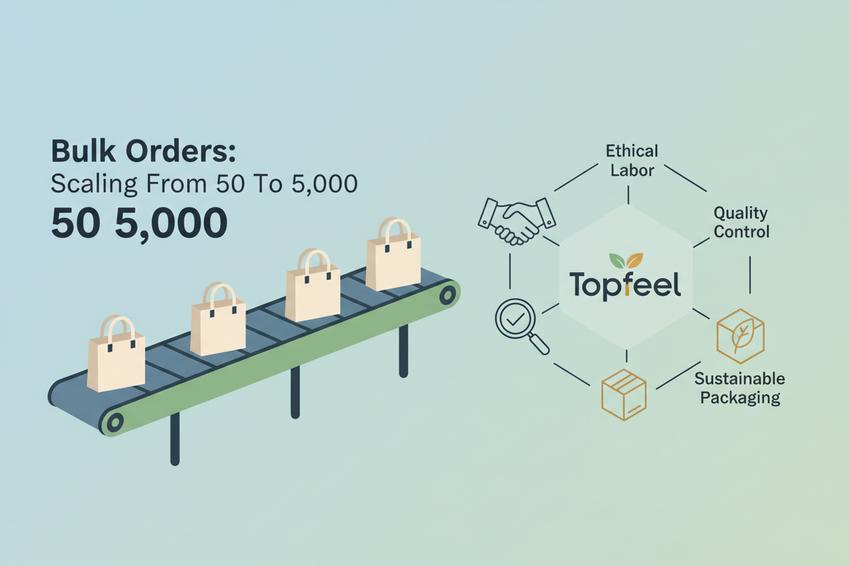
Bulk Production Workflow for Promotional Giveaway Campaigns
Managing large runs of screen printed tote bags starts with tight coordination:
- Production planning
- Define the production schedule aligned with the campaign timeline.
- Lock in material sourcing for canvas, inks, and handles.
- Select suitable printing techniques for bulk efficiency.
- Operational alignment
- Printing phase
- Calibrate screens for printed tote bags.
- Test color fastness on sample screen tote bags.
- Packaging phase
- Sort by event or region.
- Prepare labels based on distribution strategy.
- Printing phase
- Fulfillment flow
- Integrate fulfillment logistics with warehouse dispatch.
- Track daily output of screen printed tote bags.
- Sync delivery windows with venue schedules.
When brands like Topfeel handle high-volume screen printed tote bags, the workflow feels smooth, not chaotic. This is the same logic applied to mass-producing drawstring bags for events.
Ethical Labor Practices and Fair Trade Certification
High-volume screen printed tote bags demand responsible oversight. Organizations like Fair Trade Certified provide frameworks to ensure workers are treated fairly throughout the manufacturing process.
- Worker standards
- Fair contracts and fair wages
- Verified safe working conditions
- Active worker welfare programs
- Compliance framework
- Clear certification standards
- Ongoing auditing processes
- Documented supply chain transparency
- Accountability loop
- Internal reviews of printed shopping bags production
- Third-party factory inspections
- Public sustainability summaries
Ethics isn’t just a feel-good extra. It protects brand reputation and keeps bulk screen printed tote bags aligned with modern buyer expectations.
Streamlining Quality Control Checks at High Volume
When producing thousands of screen printed tote bags, random checks won’t cut it. Industry leaders utilize Lean Six Sigma methodologies to minimize defects in high-volume textile printing.
- Inspection structure
- Pre-print fabric review
- Mid-print color accuracy checks
- Final packing inspection points
- Testing criteria
- Stitch strength at handles
- Ink adhesion for screen printed tote bags
- Zipper or seam durability
- Water resistance lining tests
- Control methods
- Statistical sampling methods
- Clear defect identification logs
- Digital documentation trails
- Periodic consistency checks
- Tech integration
- AI-supported automated inspection cameras
- Batch coding for traceability
Topfeel applies layered inspection points so every batch of screen printed tote bags lands consistent, clean, and event-ready. This rigor is applied across all lines, including train cases and pro kits.
Reducing Carbon Footprint with Reusable Packaging
Sustainability scales with volume. The World Wildlife Fund (WWF) emphasizes the importance of a circular economy in reducing industrial waste.
- Material choices
- Switch to sustainable materials for inner wraps
- Replace plastic with eco-friendly alternatives
- Packaging strategy
- Smarter packaging design to reduce space
- Bulk packing ratios that cut transport emissions
- Circular flow
- Organized return logistics for reusable cartons
- Active waste reduction targets
- Verified carbon offsetting programs
- Impact tracking
- Measure CO₂ per 1,000 screen printed tote bags
- Compare freight modes
- Report annual savings
Large orders of screen printed tote bags don’t have to mean large waste. With reusable systems in place, printed tote bags can support bold campaigns and a cleaner footprint at the same time.
FAQs about Screen Printed Tote Bags
Why are screen printed tote bags ideal for promotional campaigns?
Screen printed tote bags turn daily routines into moving billboards.
- Strong visual impact through screen printing on organic cotton canvas or recycled PET fabric.
- Reinforced stitching and durable zipper closure extend life during daily essentials storage.
- Suitable for promotional giveaway, event merchandise, or gift with purchase.
Design details elevate perception:
- Clean tote bag meaning and silhouette shape
- Custom color matching for brand accuracy
- Coordinated handle strap style and hardware finish
Long-term use means repeated brand exposure, not a one-day impression.
How should artwork be prepared before bulk production?
Artwork preparation protects both creativity and budget. According to Adobe’s printing guide, vector files are essential for maintaining edge sharpness in screen printing.
Preparation typically follows a clear path:
- Confirm custom color matching on chosen materials such as nylon twill or jute fabric material.
- Review screen printing placement against the tote’s silhouette shape.
- Approve a physical sample before bulk production.
During sample approval, check:
- Print sharpness and alignment
- Lining pattern visibility
- Closure mechanism and zipper pull design balance
Careful quality control checks prevent misalignment and wasted material sourcing costs.
What sustainability features can brands highlight with screen printed tote bags?
Eco value speaks loudly when backed by action. For instance, The Global Organic Textile Standard (GOTS) ensures that the organic status of textiles is verifiable from harvesting through labeling.
Key sustainability elements include:
- Organic cotton canvas and jute as biodegradable materials
- Recycled PET fabric supporting waste minimization
- Low-impact dyes for carbon footprint reduction
- Reusable packaging for cleaner shipping cycles
Factories with fair trade certification and ethical labor practices add credibility. Sustainable manufacturing is not just a claim; it shapes how customers feel about carrying the bag.
How do premium features improve user experience in cosmetic or travel totes?
Function shapes emotional connection. Research from the Journal of Marketing Research suggests that tactile quality significantly influences brand loyalty.
For travel organization or a makeup artist kit, thoughtful features matter:
- Water-resistant lining to protect cosmetics
- Multiple compartments and internal pockets for order
- Removable dividers for flexible storage
- Durable zipper closure that feels secure
Customization options such as embroidered logo, debossed branding, or heat transfer vinyl refine the finish. When design elements and structure work together, the cosmetic bags or totes feel dependable, polished, and ready for daily life.
Screen Printed Tote Bags
screen-printed-tote-bags
the-ultimate-guide-to-designing-screen-printed-tote-bags
The Ultimate Guide to Designing Screen Printed Tote Bags
When screen printed tote bags turn into bold brand storytellers, even your bulk cosmetic bag orders start feeling like a fashion revolution.
Screen printed tote bags aren’t just freebies tossed across a trade show table—they’re walking billboards with a pulse. One sharp design and your logo is riding the subway, grabbing coffee, hitting the farmer’s market. But here’s the rub: muddy ink, off-center prints, flimsy straps. That’s how brands blow a perfectly good marketing moment.
Promotional Products Association International reports 73% of consumers own a promotional bag—and most keep it for years. That’s not swag. That’s staying power. As marketing legend Seth Godin says, “People do not buy goods and services. They buy relations, stories, and magic.”
This guide cuts straight to what keeps procurement managers up at night: color accuracy, fabric choices, eco-credibility, and bulk orders that don’t go sideways. Because when a tote feels solid and looks sharp, your brand doesn’t just show up—it sticks.
Why Screen Printed Tote Bags Matter For Brands
Screen printed tote bags show up everywhere—campus, trade shows, grocery runs. When your logo rides along on daily errands, brand vibes stick. That’s why smart companies invest in screen printed tote bags.
Enhancing Brand Visibility with Screen Printing
Screen printed tote bags turn casual carry into moving ads through:
- Design Layer
- logo placement
- Center chest print for bold design impact
- Corner alignment for subtle visual appeal
- custom graphics
- Event-specific artwork
- Limited-edition drops boosting brand recognition
- color vibrancy
- High-contrast inks
- Pantone-matched shades for sharper design impact
- logo placement
- Exposure Layer
- Daily commute
- Retail shopping
- Campus life
Screen printed tote bags, printed tote bags, and screen print bags all work the same magic: steady impressions without ad spend. A well-placed logo on branded tote bags keeps brand recognition growing naturally. The screen print process ensures that even complex designs remain crisp over hundreds of uses.
Boosting Perceived Value via Durable Zipper Closure & Reinforced Stitching
Quality shifts how people treat screen printed tote bags.
- Construction Core
- zipper closure
- Smooth glide testing (500+ pulls)
- Secure storage for tech or makeup
- reinforced stitching
- Cross-stitched handles
- Stress-point bar tacks
- Heavy canvas body for lasting durability
- zipper closure
- Performance Snapshot
| Feature | Standard Tote | Upgraded Screen Printed Tote Bags |
|---|---|---|
| Handle Load | 5 kg | 12 kg |
| Stitch Count/Inch | 6 | 10 |
| Zipper Cycles | None | 500+ |
| Avg. Lifespan | 6 months | 18+ months |
Longer longevity equals stronger quality construction perception. That’s where Topfeel steps in—delivering functional features that make screen printed tote bags feel premium, not promo. Whether you are designing handbags for retail or accessory bags for a gift set, structural integrity is non-negotiable.
Aligning Sustainability Aspects: Organic Cotton Canvas & Low-Impact Dyes
Eco appeal isn’t hype; it’s buying logic. According to the Environmental Protection Agency, textile waste is a growing concern, making jute fabric material and organic cotton essential for modern brands.
- Material Choice
- organic cotton canvas
- Certified farms
- Reduced pesticide use
- Recycled fabric options for printed tote bags
- organic cotton canvas
- Dye & Process
- low-impact dyes
- Lower water waste
- Cleaner wastewater output
- Energy-aware curing methods
- low-impact dyes
- Brand Impact
- Clear eco-friendly materials messaging
- Transparent sustainable sourcing
- Visible ethical production standards
Consumers choosing screen printed tote bags often look for environmental consciousness. When Topfeel pairs screen printing with jute or other responsible materials, screen printed tote bags become more than merch—they signal values.
3 Key Steps To Perfect Artwork Prep
Getting screen printed tote bags right isn’t just about cool graphics. It’s about prep work that saves money, avoids messy reprints, and keeps your printed tote bags looking sharp in real life. From recycled fabrics to color tuning, this guide walks through how screen print tote bags are refined before bulk production kicks off.
Step 1: Material Sourcing for Recycled PET Fabric Prints
When producing screen printed tote bags, fabric choice quietly decides everything—ink grip, durability, and that smooth retail feel. Understanding what is woven fabric helps designers select the right substrate for high-resolution logos.
- Material Base Evaluation
- Recycled PET fabric
- Source certification (GRS preferred)
- Fiber origin traceability
- Sustainability compliance
- Jute blend alternatives
- Surface roughness level
- Ink adhesion compatibility
- Recycled PET fabric
- Fabric Performance Testing
- Fabric weight
- 120–180 GSM for lightweight printed tote bags
- 200+ GSM for heavy-duty screen print tote bags
- Weave structure
- Plain weave: smoother logo edges
- Twill weave: deeper texture, rustic vibe
- Fabric properties
- Absorption rate
- Shrinkage percentage
- Tensile strength
- Fabric weight
- Material Testing Benchmarks
| Test Item | Standard Range | Impact on Screen Printed Tote Bags |
|---|---|---|
| Fabric Weight (GSM) | 140–220 | Print durability & shape retention |
| Shrinkage Rate | ≤3% | Artwork alignment stability |
| Ink Absorption (%) | 8–15 | Color vibrancy |
| Tensile Strength (N) | ≥250 | Handle strength |
| Colorfastness Grade | 4–5 | Wash resistance |
At Topfeel, material sampling happens before artwork approval, not after. That saves brands from expensive fixes when scaling screen printed tote bags production. Choosing the right thickness of cotton fabric is often the first step in ensuring the ink doesn’t bleed.
Step 2: Custom Color Matching & Screen Printing Setup
Color on screen printed tote bags has zero room for guesswork. Many brands rely on Pantone Matching Systems to ensure global consistency across different factories.
- Color Development Process
- Pantone colors
- Direct Pantone-to-ink conversion
- Brand guideline cross-check
- Ink formulation
- Pigment ratio adjustment
- Binder compatibility with recycled PET
- Ink viscosity
- Thicker ink for bold logo prints
- Thinner blend for gradient tote bag printing
- Pantone colors
- Printing Calibration Control
- Screen mesh count
- 110–160 mesh for solid graphics
- 180+ mesh for fine typography
- Printing press calibration
- Pressure alignment
- Stroke consistency
- Print registration
- Multi-color overlay precision
- Edge-to-edge alignment testing
- Screen mesh count
If your screen printed tote bags show dull reds or fuzzy outlines, it usually traces back to poor mesh choice or unstable viscosity. How does screen printing work effectively is by managing these variables meticulously.
Topfeel’s technicians run small-batch screen printed tote bags trials to confirm color accuracy before mass printing tote bags. That step alone cuts rework rates noticeably.
Step 3: Sample Approval and Quality Control Checks
Before bulk runs of screen printed tote bags start, samples go through layered inspection. Professional manufacturers often follow ISO 2859-1 standards for sampling procedures.
- Artwork & Layout Verification
- Artwork alignment
- Logo centering tolerance within ±2mm
- Handle symmetry check
- Print clarity
- Edge sharpness under magnification
- Ink bleed inspection
- Artwork alignment
- Durability & Structure Testing
- Durability testing
- 500-cycle abrasion test
- 5-wash color retention check
- Fabric integrity
- Seam stress pull
- Handle reinforcement load test
- Durability testing
- Final Production Review
- Color consistency
- Batch-to-batch comparison
- Defect identification
- Pinholes
- Ink cracking
- Misregistration
- Final inspection
- Random AQL sampling
- Packaging cleanliness
- Color consistency
Clean approval means your screen printed tote bags move confidently into full production. This process is equally critical for crossbody bags and toiletry bags where seam strength is tested by daily use.
Avoid Misalignment Errors With Simple Tricks
Getting screen printed tote bags to look clean isn’t luck. It’s about lining up the art with the bag’s build. When printing on tote, screen print tote bags, or custom screen printed tote bags, small shifts can ruin the vibe. Here’s how to keep every print tight and centered.
Centering Your Design on the Tote’s Silhouette Shape
For balanced design placement on screen printed tote bags, focus on the bag’s shape before ink hits fabric.
- Understand the frame
- Review the tote bag silhouette
- Check width vs. height
- Note strap drop impact on print area
- Measure true bag dimensions
- Flat lay measurement
- Filled-shape adjustment
- Review the tote bag silhouette
- Build a smart guide
- Create a scaled design template
- Mark a vertical and horizontal centering guide
- Align artwork for clean visual alignment
- Test before production
- Print sample screen printed tote bags
- Compare top margin, side spacing, and pocket interference
When printing tote bags screen printed for retail, the dimensions of a tote bag dictate the maximum print size. Topfeel handles this by mapping every print area to the exact bag dimensions before bulk runs.
Using Removable Dividers for Precise Screen Placement
Stable fabric equals sharp graphics on screen printed tote bags.
- Internal stabilization
- Insert removable dividers
- Lock panels inside compartments
- Prevent drag during screen printing setup
- Insert removable dividers
- External alignment
- Secure the screen frame
- Add registration marks
- Use a calibrated printing jig
- Fine-tune placement
- Apply alignment tools for edges
- Recheck precise placement against artwork grid
This matters big time for detailed tote bag screen printing. Custom screen printed tote bags with layered colors especially need tight control. No shifting. No ghosting.
Calibrating Hardware Finish and Zipper Pull Design
On premium screen printed tote bags, metal and ink must vibe together. Designers often look to Vogue’s accessory trends to ensure hardware finishes like brushed gold or matte black match the brand aesthetic.
- Hardware review
- Confirm hardware finish tone
- Match plating with ink color
- Detail coordination
- Align zipper pull design with logo axis
- Check embellishment placement near seams
- Print harmony
- Test print calibration on matching fabric
- Verify material compatibility
- Ensure full design consistency across product details
When screen printed tote bags include metallic zippers or debossed tags, off-tone hardware throws off the whole look. Topfeel keeps hardware specs synced with artwork files so handheld bags and totes stay sharp from zipper pull to bottom seam.
Bulk Orders: Scaling From 50 To 5,000
Scaling from small batches to thousands of screen printed tote bags is no small feat. When orders jump from 50 to 5,000, timing, ethics, and quality suddenly matter a whole lot more. According to the International Chamber of Commerce, supply chain efficiency is key to maintaining quality during rapid scaling.
Bulk Production Workflow for Promotional Giveaway Campaigns
Managing large runs of screen printed tote bags starts with tight coordination:
- Production planning
- Define the production schedule aligned with the campaign timeline.
- Lock in material sourcing for canvas, inks, and handles.
- Select suitable printing techniques for bulk efficiency.
- Operational alignment
- Printing phase
- Calibrate screens for printed tote bags.
- Test color fastness on sample screen tote bags.
- Packaging phase
- Sort by event or region.
- Prepare labels based on distribution strategy.
- Printing phase
- Fulfillment flow
- Integrate fulfillment logistics with warehouse dispatch.
- Track daily output of screen printed tote bags.
- Sync delivery windows with venue schedules.
When brands like Topfeel handle high-volume screen printed tote bags, the workflow feels smooth, not chaotic. This is the same logic applied to mass-producing drawstring bags for events.
Ethical Labor Practices and Fair Trade Certification
High-volume screen printed tote bags demand responsible oversight. Organizations like Fair Trade Certified provide frameworks to ensure workers are treated fairly throughout the manufacturing process.
- Worker standards
- Fair contracts and fair wages
- Verified safe working conditions
- Active worker welfare programs
- Compliance framework
- Clear certification standards
- Ongoing auditing processes
- Documented supply chain transparency
- Accountability loop
- Internal reviews of printed shopping bags production
- Third-party factory inspections
- Public sustainability summaries
Ethics isn’t just a feel-good extra. It protects brand reputation and keeps bulk screen printed tote bags aligned with modern buyer expectations.
Streamlining Quality Control Checks at High Volume
When producing thousands of screen printed tote bags, random checks won’t cut it. Industry leaders utilize Lean Six Sigma methodologies to minimize defects in high-volume textile printing.
- Inspection structure
- Pre-print fabric review
- Mid-print color accuracy checks
- Final packing inspection points
- Testing criteria
- Stitch strength at handles
- Ink adhesion for screen printed tote bags
- Zipper or seam durability
- Water resistance lining tests
- Control methods
- Statistical sampling methods
- Clear defect identification logs
- Digital documentation trails
- Periodic consistency checks
- Tech integration
- AI-supported automated inspection cameras
- Batch coding for traceability
Topfeel applies layered inspection points so every batch of screen printed tote bags lands consistent, clean, and event-ready. This rigor is applied across all lines, including train cases and pro kits.
Reducing Carbon Footprint with Reusable Packaging
Sustainability scales with volume. The World Wildlife Fund (WWF) emphasizes the importance of a circular economy in reducing industrial waste.
- Material choices
- Switch to sustainable materials for inner wraps
- Replace plastic with eco-friendly alternatives
- Packaging strategy
- Smarter packaging design to reduce space
- Bulk packing ratios that cut transport emissions
- Circular flow
- Organized return logistics for reusable cartons
- Active waste reduction targets
- Verified carbon offsetting programs
- Impact tracking
- Measure CO₂ per 1,000 screen printed tote bags
- Compare freight modes
- Report annual savings
Large orders of screen printed tote bags don’t have to mean large waste. With reusable systems in place, printed tote bags can support bold campaigns and a cleaner footprint at the same time.
FAQs about Screen Printed Tote Bags
Why are screen printed tote bags ideal for promotional campaigns?
Screen printed tote bags turn daily routines into moving billboards.
- Strong visual impact through screen printing on organic cotton canvas or recycled PET fabric.
- Reinforced stitching and durable zipper closure extend life during daily essentials storage.
- Suitable for promotional giveaway, event merchandise, or gift with purchase.
Design details elevate perception:
- Clean tote bag meaning and silhouette shape
- Custom color matching for brand accuracy
- Coordinated handle strap style and hardware finish
Long-term use means repeated brand exposure, not a one-day impression.
How should artwork be prepared before bulk production?
Artwork preparation protects both creativity and budget. According to Adobe’s printing guide, vector files are essential for maintaining edge sharpness in screen printing.
Preparation typically follows a clear path:
- Confirm custom color matching on chosen materials such as nylon twill or jute fabric material.
- Review screen printing placement against the tote’s silhouette shape.
- Approve a physical sample before bulk production.
During sample approval, check:
- Print sharpness and alignment
- Lining pattern visibility
- Closure mechanism and zipper pull design balance
Careful quality control checks prevent misalignment and wasted material sourcing costs.
What sustainability features can brands highlight with screen printed tote bags?
Eco value speaks loudly when backed by action. For instance, The Global Organic Textile Standard (GOTS) ensures that the organic status of textiles is verifiable from harvesting through labeling.
Key sustainability elements include:
- Organic cotton canvas and jute as biodegradable materials
- Recycled PET fabric supporting waste minimization
- Low-impact dyes for carbon footprint reduction
- Reusable packaging for cleaner shipping cycles
Factories with fair trade certification and ethical labor practices add credibility. Sustainable manufacturing is not just a claim; it shapes how customers feel about carrying the bag.
How do premium features improve user experience in cosmetic or travel totes?
Function shapes emotional connection. Research from the Journal of Marketing Research suggests that tactile quality significantly influences brand loyalty.
For travel organization or a makeup artist kit, thoughtful features matter:
- Water-resistant lining to protect cosmetics
- Multiple compartments and internal pockets for order
- Removable dividers for flexible storage
- Durable zipper closure that feels secure
Customization options such as embroidered logo, debossed branding, or heat transfer vinyl refine the finish. When design elements and structure work together, the cosmetic bags or totes feel dependable, polished, and ready for daily life.
References
- Facts and Figures about Materials, Waste and Recycling – epa.gov
- Pantone Matching System Coated & Uncoated – pantone.com
- ISO 2859-1:1999 Sampling procedures for inspection – iso.org
- Vogue Accessory Trends – vogue.com
- What is Six Sigma? – isixsigma.com
- World Wildlife Fund Circular Economy – worldwildlife.org
- Adobe Guide to Printing and Design – adobe.com
- Global Organic Textile Standard (GOTS) – global-standard.org
- Journal of Marketing Research – ama.org
- Textile Exchange Material Reports – textileexchange.org
- The Science of Screen Printing Inks – screenprintingmag.com
- Color Management in Textile Printing – xrite.com


.png)



4th-5th Floor, Building B2, Yin Tian Industrial Park, Xi Xiang Road, Bao'an Dist, Shenzhen, 518102 ,China